

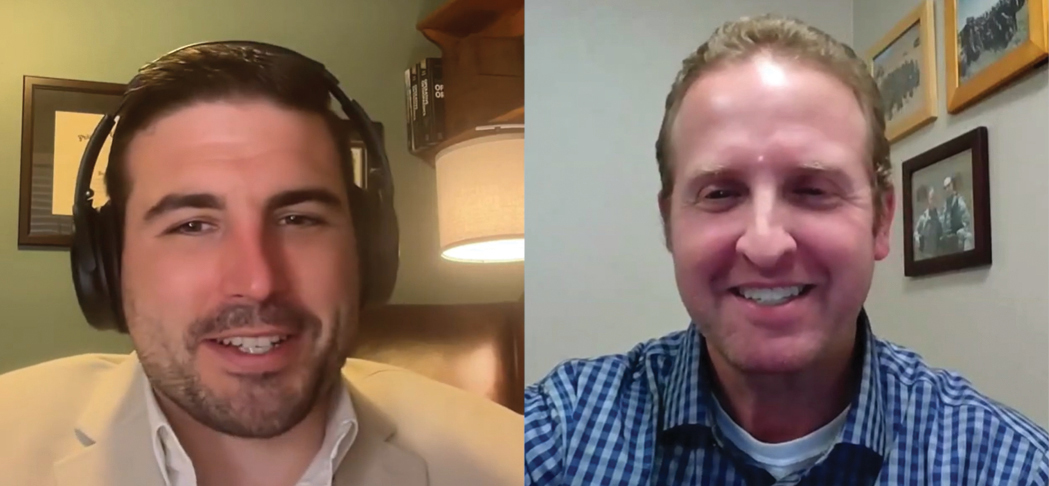
Dustin Greenhill, MD, FAAOS (right), spoke with Rex Lutz, DO, on the benefits of getting involved in research during orthopaedic residency.
Published 11/20/2025
In the latest episode of the AAOS Career Podcast, Rex Lutz, DO, chair of the Resident Assembly Executive Committee, welcomed special guest Dustin Greenhill, MD, FAAOS, pediatric orthopaedic surgeon and associate program director at St. Luke’s University Health Network, for a conversation about the challenges and rewards of getting involved in research during residency.
Dr. Greenhill shared that he did not go straight from college to medical school, choosing instead to serve in Iraq after graduating from West Point. “My soldiers thought I was crazy because I was studying for the MCAT,” he said. “When I came off of those years [in the military], I started med school two weeks later.”
While he was in medical school and residency at Temple, his mentors encouraged him to persevere after the first manuscript he wrote as a medical student was rejected. “When I read that rejection letter, I basically thought I would never write another manuscript,” he said. “Fast-forward, I rewrote that paper as a PGY5 over a weekend, and it’s published now. I just needed the orthopaedic foundation to produce a good manuscript.”
He also explained that although it was gratifying to get published, his best memories from those early-career research experiences were not linked to a PubMed ID: “I got to develop … actual friendships with certain attendings and co-residents outside the OR and clinic. I also went to a few conferences because of research, and that really enhanced my academic appreciation for orthopaedics outside of my residency program alone.”
The value of research and mentorship
Dr. Greenhill emphasized the importance of keeping an open mind and engaging in diverse research projects, as well as having the tenacity to see projects through to completion. He recommended that residents who want to get involved in research should start early (as PGY1s), set realistic goals, and not hesitate to reach out to others for guidance. Residents should “focus on projects they can realistically complete at their institution or study groups [that] they can contribute to if they can’t complete a project themselves,” he said.
Dr. Greenhill expressed how rewarding it is for him to see his own mentees succeed, whether they are presenting at conferences or publishing their first paper. “It’s like watching a family member play in a sporting event,” he said. “It makes the extra time and effort pay off.”
Balancing residency, research, and leadership
The conversation also explored strategies for balancing research with clinical responsibilities. Dr. Greenhill recommended optimizing the early years of residency. “There’s a common saying, ‘If you wait until the last minute, it only takes a minute.’ That is completely not true in research,” he said. “If you keep waiting, you’ll wait forever. You’ll be busy doing different things in different years. Just don’t hesitate to start.”
He also said residents should not get involved with projects they don’t think they can finish or that require a “yes” answer to get published. Choose projects, he added, where the question is worth answering regardless of the answer. He acknowledged that there are challenges — including institutional red tape and the difficulty getting published in a high-impact journal — but offered reassurance that persistence and the support of mentors can help residents overcome such hurdles if they truly want to be involved in research.
Dr. Greenhill explained that even those who pursue research for career advancement rather than a genuine passion for investigation can discover deeper interests and personal fulfillment along the way.
Tune in to the episode to learn more about how research can help shape a resident’s career.