

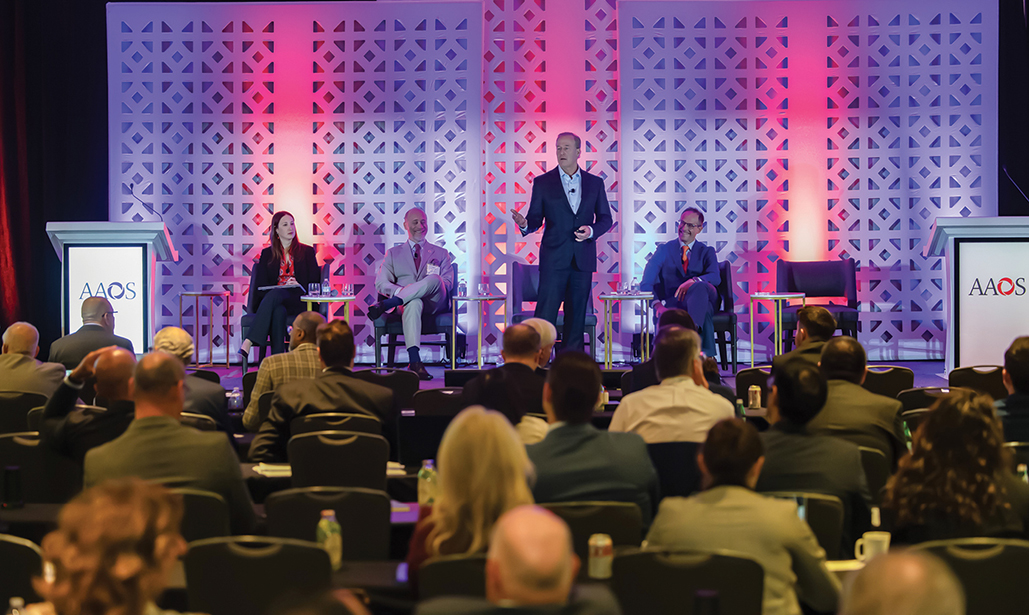
Panelists engage with attendees during educational sessions.
Published 11/20/2025
In September, more than 270 AAOS members and orthopaedic leaders — including the AAOS Board of Directors, Board of Councilors, Board of Specialty Societies, residents, and invited guests — gathered in Washington, D.C., for the 2025 AAOS Combined National Orthopaedic Leadership Conference (NOLC)/Fall Meeting. The event provided a forum for organizational business, educational programming, and impactful advocacy during Capitol Hill Day. Over two days, participants attended symposia addressing a range of timely and critical topics for the orthopaedic community.
Recent developments in medical liability reform
One session covered a broad range of topics related to recent updates in medical liability reform at both the state and federal levels, touching on topics such as the ACCESS Act, sports medicine, NIL (Name, Image, and Likeness), and tort and liability reform. Participants were encouraged to support legislative solutions and advocate for reform by promoting changes to the current medical liability system, which creates barriers between physicians and patients and fosters uncertainty in critical care situations.
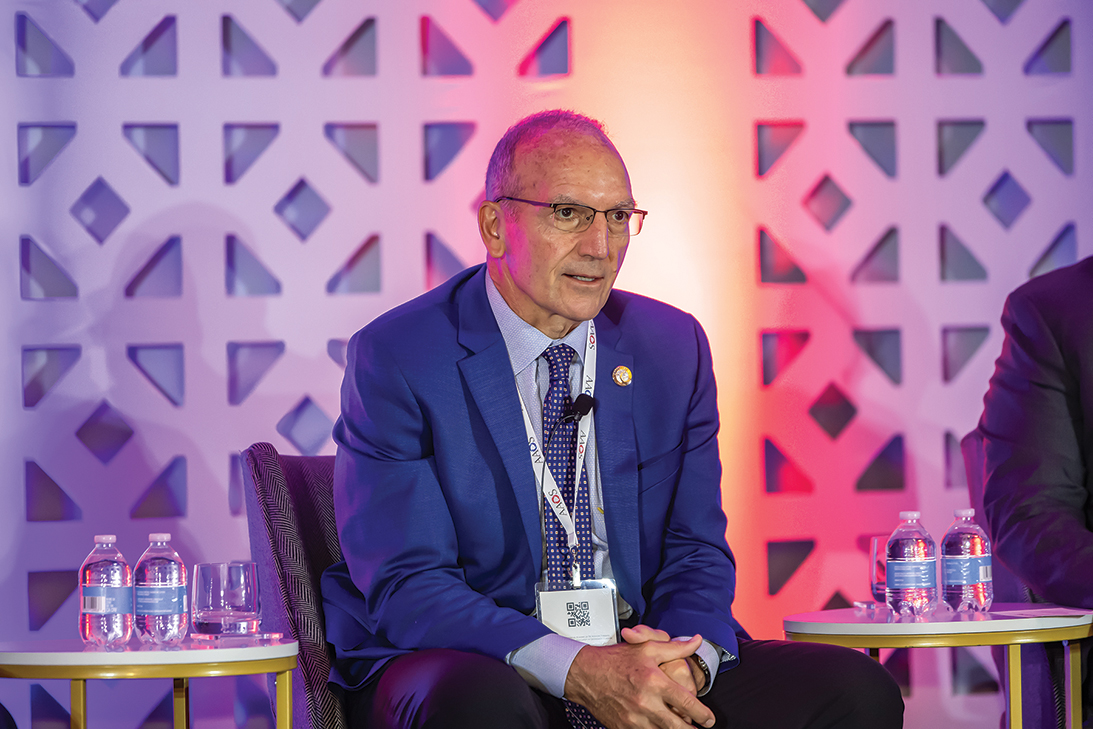
AAOS President Annunziato (Ned) Amendola, MD, FAAOS, answers questions from attendees at the 2025 AAOS Combined National Orthopaedic Leadership Conference (NOLC)/Fall Meeting.
Asset protection
In another session, participants reviewed essential asset-protection considerations, including asset structuring, liability insurance, estate planning, and business-entity management.
Practical steps to safeguard personal and practice assets from legal and financial risks were provided. Attendees gained an understanding of creditor protection and the importance of implementing creditor protection strategies to shield assets from high-value lawsuits. It was also noted that state laws differ considerably regarding community property and creditor-exempt assets.
Prior authorization: Legislation and new challenges
Current developments in prior-authorization policy, including recent Centers for Medicare & Medicaid Services (CMS) regulations and pending federal legislation for statutory codification, were covered during the session. Discussions included CMS and insurer policy changes affecting inpatient versus outpatient determinations, particularly Medicare Advantage alignment with fee-for-service standards, and the WISeR (Wasteful and Inappropriate Service Reduction) Model’s artificial intelligence (AI)-driven retroactive review processes for assessing surgical indication. Prior-authorization rules and regulations are facing a new frontier with the Trump administration and Congress. The Improving Seniors’ Timely Access to Care Act would codify current regulation to streamline prior authorization in Medicare Advantage.
Physician-payment reform updates
Attendees also received a summary of the recent proposed changes to how Medicare reimburses physicians based on the calendar year 2026 Medicare Physician Fee Schedule Rule released in July 2025. If finalized, this rule will lead to significant reimbursement cuts for orthopaedic surgeons.
Additionally, panelists examined changes and threats to the American Medical Association/Specialty Society Relative Value Scale Update Committee, a key mechanism for physicians to provide CMS input on reimbursement policies. Attendees received valuable information about how these policies will impact orthopaedic surgery.
AI, orthobiologics, and the shifting regulatory landscape
This session examined the current crossroads in orthopaedics, where political upheaval, regulatory shifts, and evolving technologies such as AI and orthobiologics are reshaping the field. Speakers highlighted the decline of trust in both physicians and government institutions, emphasizing that orthopaedic surgeons should remain central voices of expertise and leadership in patient care. Advocacy is critical, and deregulation can both drive innovation and create risks, making it essential for professional societies to engage policymakers, defend evidence-based standards, and maintain trust.
The research horizon in orthopaedic surgery
This symposium highlighted the critical role of orthopaedic research in advancing innovation and improving patient outcomes, emphasizing that its value extends beyond orthopaedics to multiple medical specialties. Speakers underscored the importance of collaboration across societies, noting that although organizations may appear to have distinct agendas, there is often significant overlap in priorities and shared opportunities. Examples such as molecular MRI, AI and machine learning, 3D printing, and surgeon-wellness initiatives were presented as areas where cross-disciplinary efforts are driving meaningful progress. Orthopaedic research drives innovation across medicine, and the Orthopaedic Research and Education Foundation (OREF) plays a critical role in sustaining research. Although funding challenges remain a major obstacle, sustaining innovation requires a stronger investment and support for the next generation of clinician-scientists.
Cybersecurity and AI
In today’s rapidly evolving digital environment, cyberattacks, especially those enhanced by AI, pose an increasingly serious risk to healthcare professionals and their practices. Attendees received an overview of the current cybersecurity landscape, financial and legal ramifications of noncompliance, and the penalties organizations have faced following successful attacks. Data breaches are increasing in frequency, cost, and severity, especially in healthcare. AI tools bring both efficiency benefits and new security challenges. Quarterly cybersecurity updates will be available to AAOS members.
Unifying the ‘House of Orthopaedics’ through advocacy
As the health-policy landscape continues to evolve in complexity and urgency, coordinated advocacy across the “House of Orthopaedics” is critical to advance the profession and protect patient access to musculoskeletal care. Attendees of the NOLC/Fall Meeting received strategies and resources to amplify the orthopaedic voice at the state, regional, and national levels. Together, these perspectives will provide a blueprint for how all orthopaedic societies can align around shared priorities; overcome policy challenges; and build a strong, unified advocacy front. The Political Action Committee of the American Association of Orthopaedic Surgeons (OrthoPAC) is the nonpartisan political arm of AAOS, providing direct access to policymakers, supporting ortho-friendly candidates, and ranking #3 among medical PACs in dollars raised. The Office of Government Relations (OGR) streamlines federal advocacy infrastructure, including regulatory reform, payment policy, and coalition-building on Capitol Hill. Attendees were encouraged to engage with OrthoPAC and utilize OGR resources when connecting with lawmakers.
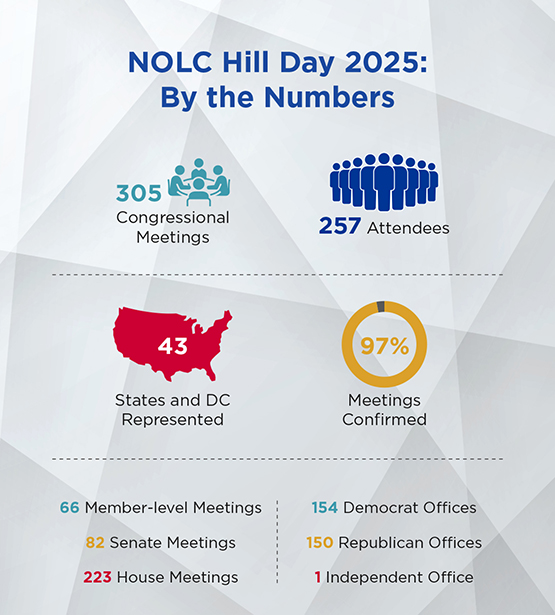
The meeting culminated with Capitol Hill Day, where more than 250 participants held 305 congressional meetings to advocate for healthcare policy priorities affecting orthopaedic surgeons and their patients. The event concluded with a reception hosted by OrthoPAC honoring congressional champions of orthopaedic advocacy.
OrthoPAC is affiliated with and connected to the 501(c)(6) Association. OrthoPAC is not connected to or affiliated with the American Academy of Orthopaedic Surgeons, which is a 501(c)(3) organization.