

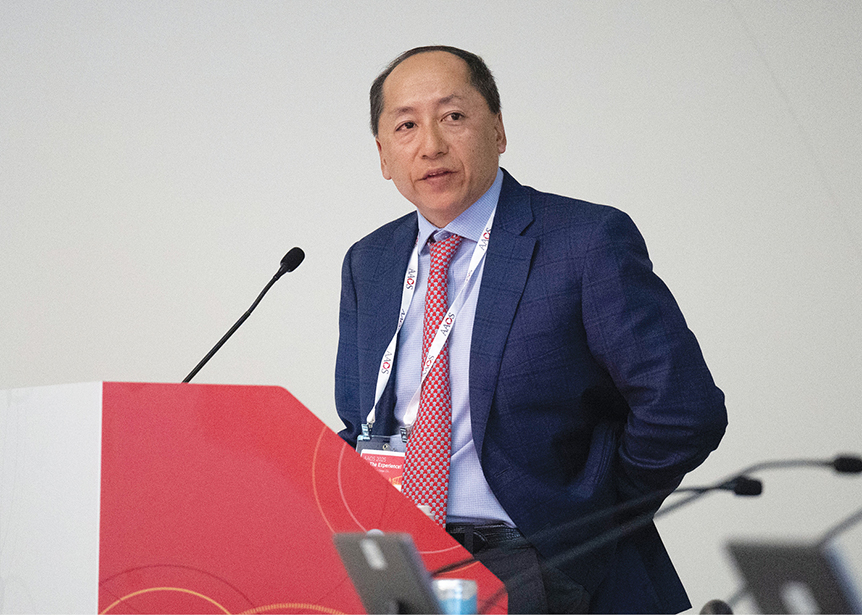
Steven Lee, MD, FAAOS, urged orthopaedic trainees to embrace every opportunity to learn and do as much as they can, emphasizing that diligence in their training is key to success.
Published 10/19/2025
|
Leah Lawrence
At the AAOS 2025 Annual Meeting’s Resident and Fellows Symposium, titled “Sage advice for your sojourn and voyage,” early-career orthopaedic surgeons were treated to a variety of wisdom, truths, and perspectives to take along as they transition out of residency into the first steps of their careers and beyond.
“For most of you, your main thought is that you want to be a great surgeon,” AAOS Past President Paul Tornetta, MD, PhD, FAAOS, said as he opened the session. He emphasized the importance of focusing on the personal component of medicine. “You can be taught to be [a] good surgeon [for a patient] — what you might not be able to do is have the human skills to talk to that same individual.”
Dr. Tornetta encouraged early-career surgeons to never forget that each person they operate on is someone else’s loved one, and to remember that practicing gratitude can help put things in perspective.
Handling the jitters
Michael T. Archdeacon, MD, FAAOS, of the University of Cincinnati, talked about early-career jitters and how to identify and address early anxieties.
“Everyone is nervous when they start practice … or at least they should be,” Dr. Archdeacon said. “I am nervous now, and I have been in practice for 25 years.”
After training is over, there is suddenly full responsibility for patients and outcomes. Orthopaedic surgeons have to manage their ORs without necessarily having someone to bail them out. Income is dependent on work output. They have to deal with reimbursement challenges from insurance companies. Often, they are living in a new home in a new neighborhood and working at a new hospital.
There are certain strategies that can help drive success. Dr. Archdeacon advised attendees to pay attention to how they present themselves.
“I have no problem wearing scrubs when I am going into surgery, but when I walk around the hospital, I put on the white coat,” he said. “My patients expect me to look like a doctor.”
Be mindful of language, Dr. Archdeacon advised. What would you think if the person next to you said it to you? Do not speak just to be heard.
He encouraged attendees to develop a career plan, to identify where they are and where they would like to be. Is the plan to spend more time in clinical practice, deliver more presentations and have more publications, or serve on committees and in leadership roles? He encouraged new surgeons to be efficient in surgery and have no wasted motions. Make a preoperative plan and a mental map. After each surgery, look back to see what worked or did not.
As a final thought, Dr. Archdeacon added, “You can never be too polite, too overdressed, or too early — except to a dinner party.” He also echoed Dr. Tornetta’s advice and encouraged attendees to practice being grateful.
Never stop learning
Steven Lee, MD, FAAOS, of New York Orthopedics, gave a candid overview of what he wished he had learned in residency. To Dr. Lee, surgical training should be as close to Navy SEAL training as possible — otherwise it is a disservice.
“Don’t look for the easy way out,” he said. This type of rigorous training means doing as many cases as possible, reading as much as possible, and knowing anatomy cold.
As an attending, Dr. Lee shared that he does whatever it takes to get the job done. He has turned over plenty of ORs, including scrubbing floors. He knows how to do everyone else’s job — except, possibly, the anesthesiologist.
Knowing the full spectrum of work performed in the OR is important to be prepared for what the future has in store in one’s practice. “You will find yourself operating in the middle of the night with a skeleton crew,” Dr. Lee said.
Years into his career, Dr. Lee shared that he still calls all his patients the night after the surgery. “Patients are scared. They have a million questions,” he said. The small moment of connection can help assuage their concerns.
Dr. Lee closed his portion of the panel by advising everyone to be kind to their colleagues: “We are way better and stronger together.”
Handling adversity
In her talk, Alexandra Page, MD, FAAOS, who runs a private practice in San Diego, said to not always expect smooth sailing and blue skies. Learning to overcome adversity is an important part of a successful career.
People may think of their professional life, health, personal life, and finances as siloed. “The reality is that all of these things are fully integrated,” Dr. Page said. “If something bad happens in one part of life, it ripples.” She shared just a few of the hurdles that occurred in her life, including an unexpected pregnancy, divorce, and the death of a spouse.
There are some things that early-career professionals can do to better prepare themselves. Find a good professional fit, she advised. Sometimes, the next professional step may not be exactly what you planned. “Don’t feel bad if you don’t get it right,” Dr. Page said.
She emphasized the importance of spending time with friends and family: “Someone else can do our job, but there is no one else who can be that spouse or partner.”
Leah Lawrence is a freelance writer for AAOS Now.