

Published 8/30/2026
|
Wilford Gibson, MD, FAAOS
At a Glance
- AAOS expressed alarm with the Centers for Medicare & Medicaid Services' calendar year 2027 Medicare Physician Fee Schedule proposed rule.
- AAOS urges CMS to withdraw the proposed policies that threaten patient access to high-quality musculoskeletal care.
- After the announcement of the proposed rule, the musculoskeletal care community united to stand up for the orthopaedic profession and patients.
Estimated read time: 5 minutes
We have arrived at a critical crossroads for orthopaedic surgeons. An existential threat is reshaping our profession, and our response will define its future.
As you may have seen, the Calendar Year 2027 Medicare Physician Fee Schedule (MPFS) proposed rule includes several provisions that, together, represent one of the most significant threats to independent orthopaedic practice in decades. In more than 30 years as a private-practice physician, I do not recall a threat to the viability of the orthopaedic profession as serious or far-reaching as the one we face today. Independent practices are already dwindling, and this may be the final straw that pushes physicians to sell their practices to hospitals and larger health systems.
As orthopaedic surgeons know all too well, once independent practices disappear, they rarely return. This shift is not just an issue of reimbursement; it is a fundamental threat to patient access. Fewer community-based practices mean fewer choices, longer wait times, and reduced access to care.

Wilford Gibson, MD, FAAOS
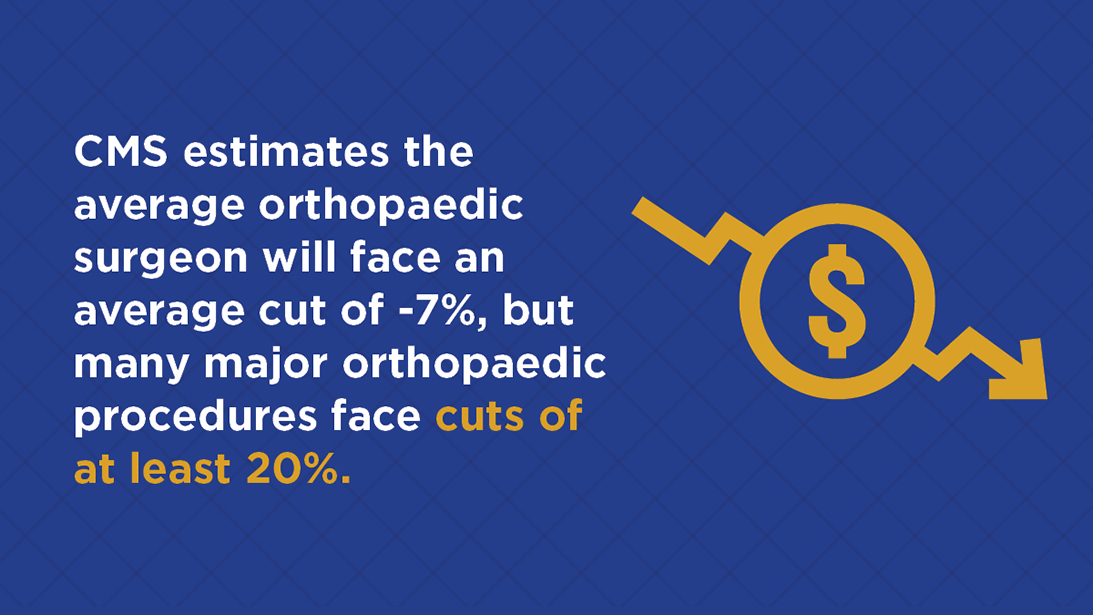
These provisions will also have a direct impact on the type of care we are able to provide to our patients. Many major joint replacement procedures — including total hip arthroplasty, total knee arthroplasty, total shoulder arthroplasty, and shoulder hemiarthroplasty — are facing cuts of roughly 20%. A nearly 20% reduction in payment for procedures that require significant physician expertise, operating time, and resources would place substantial financial pressure on practices, especially those that are independent, and could ultimately make it difficult to continue providing these services at the same level and volume.
In the weeks following the announcement of the proposed rule, I was inspired to see the musculoskeletal care community come together to stand up for our profession and patients. During Orthopaedic Advocacy Week in August, our members sent hundreds of letters to both Congress and the Centers for Medicare & Medicaid Services (CMS) expressing their concern and encouraging Congress to work with the agency to maintain the current 2026 values and work with physicians to develop a more stable and sustainable approach to Medicare physician payment.
Your efforts do not go unnoticed. When we share personal accounts of how proposed policies affect a patient recovering from a complex fracture, a young athlete hoping to return to competition, or an older adult striving to maintain independence, we open lawmakers’ eyes to the real human impact of legislation. At the same time, your stories also help policymakers understand how reimbursement cuts, administrative burdens, and other regulatory challenges threaten the viability of our practices and our ability to deliver timely, high-quality musculoskeletal care.
---
Related Content
- AAOS sounds alarm on CMS Medicare proposal that drives consolidation and harms patient access to care (AAOS Now)
- CMS Payment Resource Center (AAOS Office of Government Relations [OGR])
- CY27 Payment Summary (OGR)
- CY27 Proposed Rule Overview Slides (OGR)
- Communications Toolkit (OGR)
---
Reforming our current payment system is no doubt an uphill battle, but orthopaedic surgeons have never shied away from a challenge. AAOS has teamed up with allies across the healthcare industry by joining the Same Day Care Coalition, a group that advocates for Medicare policies allowing patients to receive comprehensive medically necessary care during a single visit.
Together, we are in conversation with policymakers to discuss the best ways to address challenges in the payment system, including how this proposed Medicare rule discourages physicians from providing care in one visit. The Coalition is working with CMS, Congress, and other stakeholders to make sure that Medicare payment policies:
- preserve timely access to high-quality, coordinated care in communities across the country;
- allow physicians to provide medically necessary evaluation and treatment during a single patient visit;
- are supported by sound clinical evidence and accurately reflect the work required to care for Medicare beneficiaries; and
- protect independent physician practices that expand patient choice and deliver efficient, community-based care.
Amid these efforts, we have also made great progress in addressing many of the other policy issues impacting musculoskeletal care. On the regulatory side, CMS’ final FY2027 Inpatient Prospective Payment System rule included a demonstration program allowing physician-led hospitals to opt into the Transforming Episode Accountability Model — a demonstration we strongly supported in our comment letter to the agency. We celebrated the House Appropriations Committee passing the Fiscal Year 2027 Labor–HHS bill with $685.5 million for the National Institute of Arthritis and Musculoskeletal and Skin Diseases, well above the proposed level in the Administration’s budget request, which sought to cut funding by more than $47 million.
The Improving Seniors’ Timely Access to Care Act (H.R. 3514), which would prioritize patient care over paperwork by modernizing and streamlining the prior authorization process in Medicare Advantage (MA), also reached several significant milestones this summer. After securing an overwhelming bipartisan supermajority of 290 House cosponsors, the bill then passed through the Energy and Commerce and Ways and Means committees unanimously. The Seniors’ Act is now ready for a full House floor vote, bringing us one step closer to mandating electronic prior authorization for MA plans, standardizing transactions and clinical documentation requirements, and increasing transparency around MA prior authorization practices.
On the Senate side, a group of Republican, Democrat, and Independent lawmakers came together to introduce the Provider Reimbursement Stability Act (S. 5180) to combat the increased financial pressures from declining physician reimbursement. S. 5180 would increase the budget neutrality threshold of the MPFS from $20 million to $57 million in 2028 and limit changes to the conversion factor, capping variances at 2.5%. AAOS previously endorsed a version of this legislation that was introduced in the House earlier this year and passed unanimously through the Ways & Means Committee.
While our government relations team is hard at work in Washington, visits to Capitol Hill are just one piece of the advocacy puzzle. Change often starts in our own communities. Get to know your local and state lawmakers, invite them to visit your practice or hospital, attend their town hall, or share a patient story that shows how these policies impact the ability of our practices to serve patients.
As we enter the final months of 2026, we will continue our fight for a healthcare system that allows orthopaedic surgeons to thrive. That means addressing the challenges we face today while setting the foundation for a future that allows our practices to remain strong. I encourage you to continue sharing your powerful stories and speaking out on behalf of your colleagues and patients. Whether you are new to advocacy or have been engaged for years, your perspective as an orthopaedic surgeon matters.
Wilford K. Gibson, MD, FAAOS, is the 2026-2027 AAOS president and a partner at Atlantic Orthopaedic Specialists, specializing in patient-specific and robotic hip and knee replacement with minimally invasive surgical techniques. He also serves as a volunteer team physician for Old Dominion University football and basketball programs.