

Published 5/28/2026
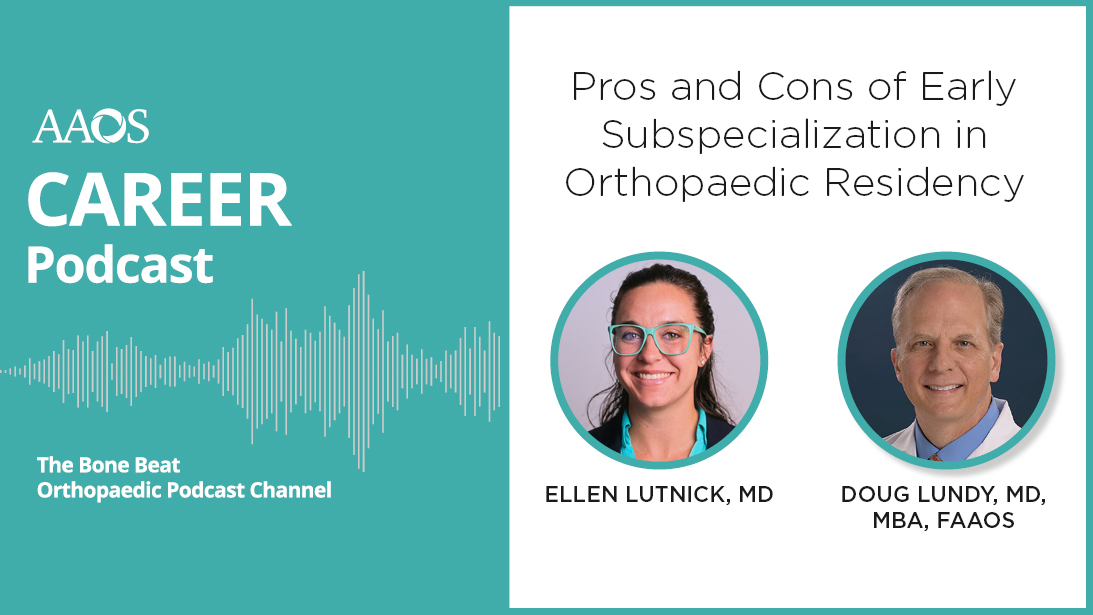
Ellen Lutnick, MD, opened her first episode as host of the AAOS Career Podcast by welcoming Doug Lundy, MD, MBA, FAAOS, a trauma surgeon at St. Luke’s University Hospital in Bethlehem, Pennsylvania, to discuss the potential benefits and pitfalls of early subspecialization during orthopaedic training.
Dr. Lundy described early subspecialization as more than a simple interest, explaining that it involves residents disproportionately directing time, rotations, and case exposure toward one subspecialty earlier than intended in a comprehensive orthopaedic curriculum.
Drawing from his experience in private practice, academic medicine, and leadership within orthopaedics, he emphasized that residency certification remains focused on general orthopaedic surgery. Therefore, he cautioned residents against narrowing their career options too quickly, stating a surgeon’s board certification “doesn’t say trauma or joints or sports. It says orthopaedic surgery.”
Benefits and risks of focusing too early
Dr. Lutnick then asked Dr. Lundy whether early subspecialization is intended to improve skill acquisition or fellowship preparedness. Dr. Lundy acknowledged that entering fellowship with a stronger baseline exposure could help some residents extract more value from training. However, he cautioned that early fixation often creates anxiety for residents who later discover a different passion, noting many trainees enter residency confident in one path only to pivot later after exposure to other subspecialties.
Dr. Lundy emphasized that residents should remain open to all options early on in their training and that the right path will eventually become clear: A subspecialty is not a choice, he said, it is “a calling.”
The value of broad training and mentorship
Elaborating on the potential disadvantages of early subspecialization, Dr. Lundy noted residents learn critical skills from rotations outside their eventual subspecialty. He explained exposure to diverse fields strengthens judgment and technical versatility. He also pointed out that board examinations reflect an expectation of general competence, noting part one assesses comprehensive knowledge rather than subspecialty mastery.
Dr. Lundy also cautioned that early subspecialization could limit mentorship opportunities, since influential mentors often come from outside a resident’s chosen field. He encouraged trainees to cultivate relationships broadly across orthopaedics, as professional growth often occurs well beyond one’s niche.
Guidance for residents navigating the decision
As the conversation ended, Dr. Lutnick asked how residents should manage pressure to commit early while keeping their options open. Dr. Lundy identified the third year as a reasonable time to begin narrowing interests. He advised against premature decisions that ignore later rotations, such as pediatrics, which frequently inspire unexpected pivots.
When addressing fellowship selection, Dr. Lundy explained how programs value curiosity and humility more than early technical confidence, saying the most important quality fellowship directors look for is “a teachable spirit.” Fellowship, he reminded listeners, exists specifically to deepen subspecialty expertise.
He urged residents not to choose their subspecialty based on compensation or lifestyle or other factors that inevitably change. Instead, he encouraged trainees to pay attention to what energizes them daily and pursue the subspecialty they truly feel they cannot live without.
Listen to episode 44 of the AAOS Career Podcast and subscribe to catch future episodes and gain more insights on professional development, research, and leadership in orthopaedics.