

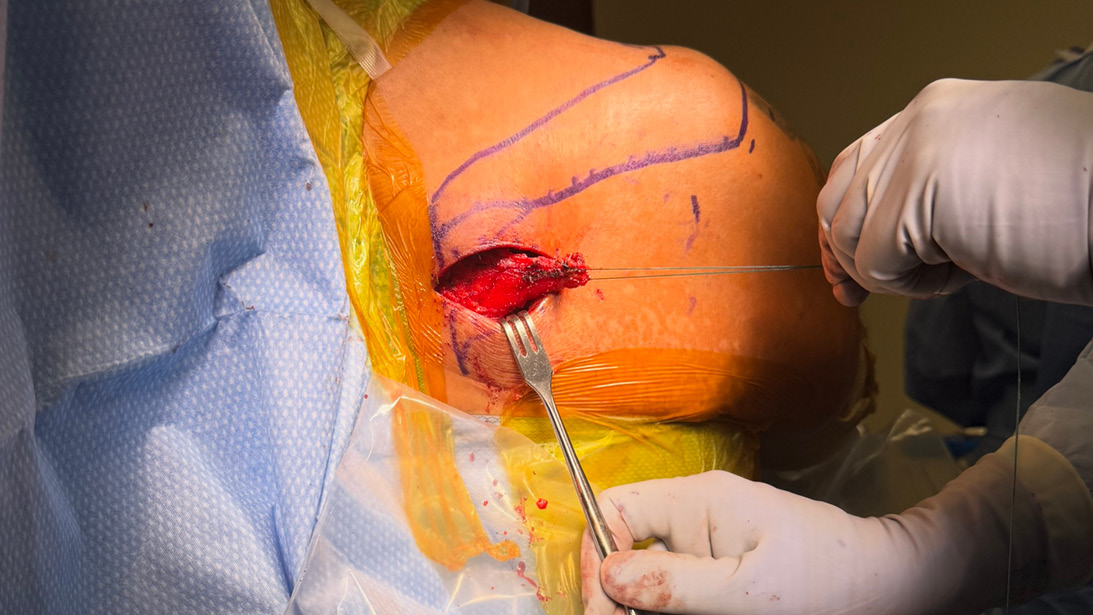
Figure 2: Intraoperative photograph demonstrating the harvested lower trapezius muscle tendon.
Courtesy of Abdulaziz F. Ahmed, MD
Published 11/19/2026
|
Frederick Mun, MD; Abdulaziz F. Ahmed, MD
At a Glance
- Careful patient selection is essential because advanced arthritis, pseudoparalysis, or substantial stiffness may favor arthroplasty.
- Transfer selection depends on the cuff deficiency location, preoperative motion and strength, and joint status.
- Muscle-tendon transfers can restore function in selected patients with irreparable rotator cuff tears.
Estimated reading time: 4 minutes
“Irreparable” rotator cuff tears (RCTs) are a common and challenging pathology encountered by orthopaedic shoulder and sports medicine surgeons. These tears are characterized by substantial tendon retraction and limited tendon excursion and are often associated with varying degrees of muscle degeneration, fatty atrophy, and infiltration (Figure 1) that precludes successful primary repair. Multiple factors, including patient demographics, chronicity, tendon retraction, muscle atrophy, fatty infiltration, and glenohumeral pathology, must be considered when determining treatment options.
It is important to distinguish “massive” RCTs from “irreparable” RCTs. A massive tear refers to the size of the RCT, while irreparability reflects the inability to mobilize and repair the tendon to its anatomic footprint.
In select patients, muscle tendon transfers (MTTs) can restore shoulder function when there is an irreparable RCT. The choice of transfer depends on the location and specific cuff deficiency, preoperative range of motion and strength, presence of arthritis or stiffness, and the patient’s goals and functional demands. MTTs can be particularly useful in younger or active patients who are candidates for joint preservation.
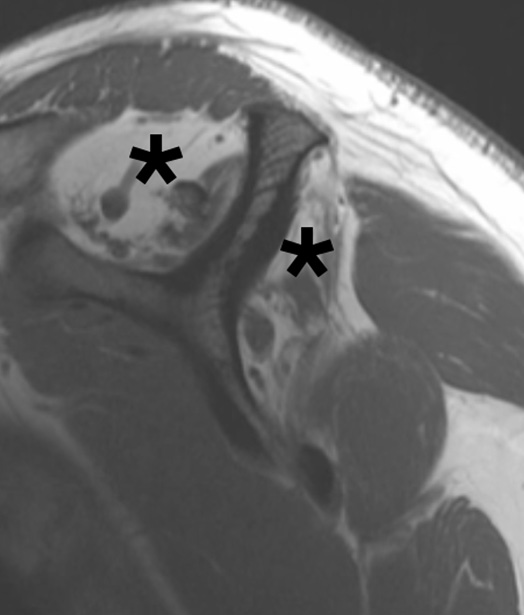
Figure 1: A sagittal MRI image depicting advanced fatty infiltration of the supraspinatus and infraspinatus muscles (*) is one of the important defining factors of irreparable rotator cuff tears.
Courtesy of Abdulaziz F. Ahmed, MD
Figure 2: Intraoperative photograph demonstrating the harvested lower trapezius muscle tendon.
Courtesy of Abdulaziz F. Ahmed, MD
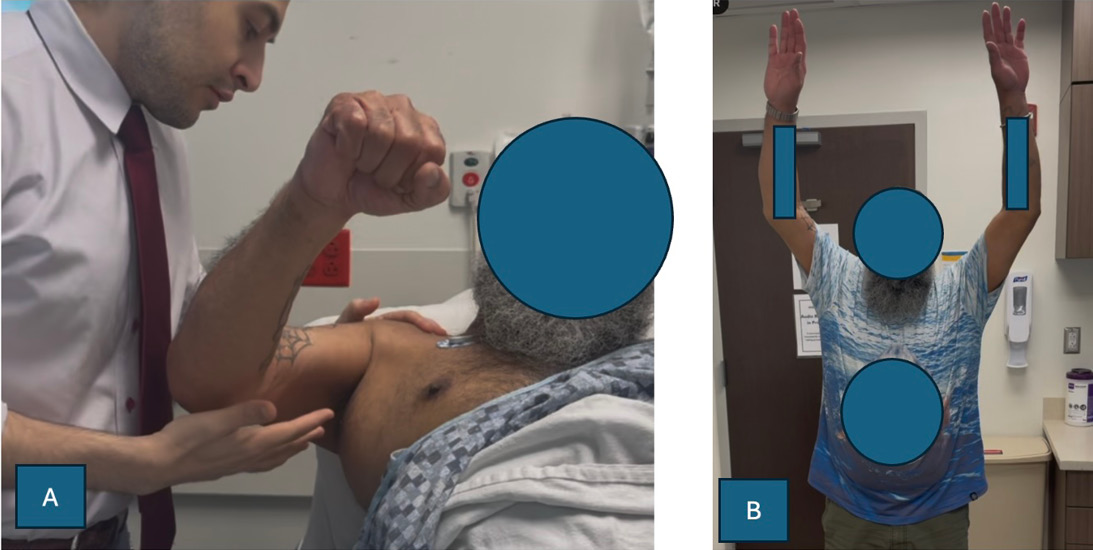
Figure 3A: A 53-year-old, right-hand-dominant active male mechanic presented with an irreparable posterosuperior cuff tear, severe fatty infiltration of the supraspinatus and infraspinatus, and loss of external rotation. On exam, he had approximately 60 degrees of forward elevation, -10 degrees of external rotation, and a positive external rotation lag sign. He had no glenohumeral arthritis or stiffness. Figure 3B: This is the same patient’s result after six months following LTTT, demonstrating restoration of range of motion and strength.
Courtesy of Abdulaziz F. Ahmed, MD
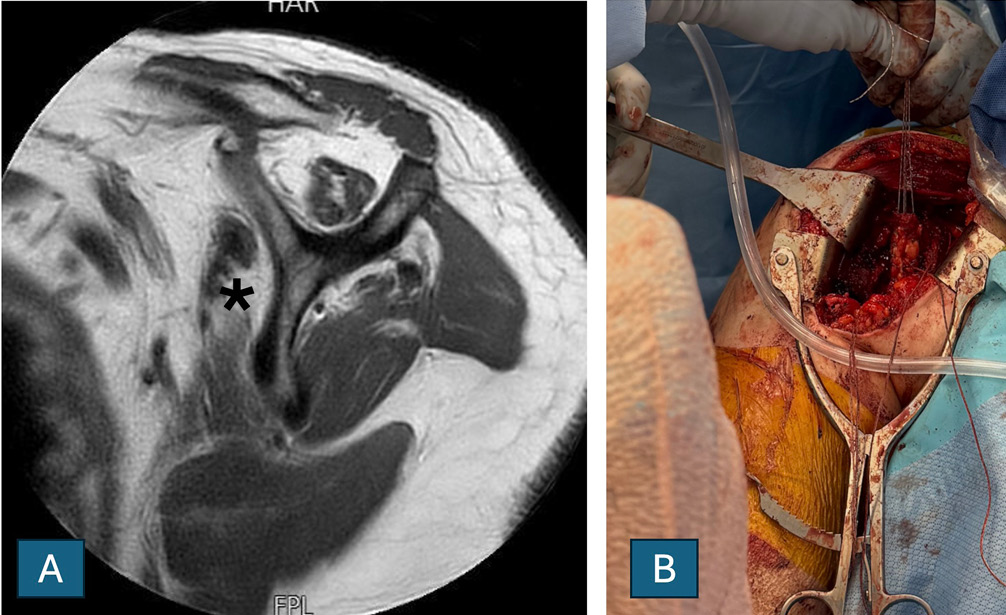
Figure 4: A 56-year-old, right-hand-dominant male surgeon presented with a 30-year history of right shoulder pain and three shoulder dislocation episodes. On exam, he had 140 degrees of forward elevation with 4/5 strength, 50 degrees of external rotation with preserved strength, and positive bear hug and belly press tests. Imaging demonstrated an anterosuperior cuff tear with severe fatty infiltration of the subscapularis (Figure 4A). He had no glenohumeral arthritis or stiffness. LDTT was selected (Figure 4B) because of his high functional demand, preserved external rotation and forward elevation, and isolated subscapularis insufficiency.
Courtesy of Abdulaziz F. Ahmed, MD
Tendon transfers can address irreparable posterosuperior rotator cuff tears
The posterosuperior rotator cuff entails the supraspinatus, infraspinatus, and rarely the teres minor. Surgeons have traditionally used a latissimus dorsi tendon transfer (LDTT) for irreparable posterosuperior RCTs. Although the latissimus is normally an adductor and internal rotator, its tendon can be redirected to provide external rotation. First introduced during the late 1980s, this treatment has demonstrated improved patient-reported outcomes, pain, elevation, and external rotation in clinical studies. In one series of 115 patients, there was a 90% clinical success rate, with significant improvement in constant scores and American Shoulder and Elbow Surgeons (ASES) scores. Only 4% required a conversion to shoulder arthroplasty. A recent systematic review of 17 LDTT studies involving 585 shoulders also demonstrated substantial improvements in patient-reported outcomes, though failure rates had considerable variability among included studies.
More recently, the lower trapezius tendon transfer (LTTT; Figure 2) has emerged as an alternative, which presents a biomechanically appealing option. The lower trapezius has a line of pull and activation pattern that are most similar to the infraspinatus and provides a favorable external rotation moment arm. LTTT clinical studies have demonstrated promising improvements in pain, disability scores, and function. In one series of 41 patients, 90% demonstrated significant improvement in clinical outcomes and 36 of the patients had improved external rotation strength.
Both LDTT and LTTT are viable options, but how does the choice between these transfers determine outcomes? Choosing between LDTT and LTTT is dependent on patient anatomy and preoperative motion and strength. One comparative study of LDTT versus LTTT demonstrated similar overall patient-reported outcomes, with LTTT showing better external rotation function and ASES scores. Longer symptom duration, Hamada grade 3 changes, and true shoulder pseudoparalysis were also shown to be associated with worse outcomes following LTTT. LTTT is biomechanically sound and offers a relatively safe, straightforward harvest; the remainder of the procedure can be completed arthroscopically. Favorable outcomes depend on appropriate indications (Figure 3).
Irreparable anterosuperior RCTs
Anterosuperior rotator cuff tears typically affect the subscapularis with or without involvement of the supraspinatus. Pectoralis major tendon transfer (PMTT) has traditionally been used in irreparable anterosuperior tears to counter loss of subscapularis function and anterior stability. PMTT was previously considered the gold standard for this pathology, but clinical results have varied given the wide range of transfer techniques (i.e., differences in muscle routing and selecting the transferred portion of the muscle). In addition, the pectoralis major line of pull is not in line with the subscapularis. As such, PMTT results in anterosuperior instability, leading to failure.
---
Related Content
- AAOS CODOrthoXpress: Management of Both Repairable and Irreparable Cuff Tears: From Physical Therapy to Arthroscopic Surgery to Muscle Tendon Transfer (AAOS OnDemand Course)
- Orthopaedic Fundamentals: Rotator cuff repair evaluation, visualization, and diagnostic arthroscopy (AAOS Now)
- Orthopaedic Fundamentals: Rotator cuff repair tear assessment and repair principles (AAOS Now)
---
LDTT to the lesser tuberosity has grown in popularity as a reasonable alternative for irreparable subscapularis tears given that the latissimus dorsi is naturally an internal rotator and shares a similar line of pull with the subscapularis (Figure 4). A systematic review comparing outcomes of PMTT and LDTT showed no difference in complication rate, improvement of active internal rotation, or subjective shoulder scores; however, LDTT demonstrated significantly greater constant score, active forward elevation, abduction, and belly press strength. Although outcomes are, overall, encouraging for LDTT, persistent anterior subluxation remains an issue. In a series of 56 patients undergoing LDTT for irreparable subscapularis tears, there was significant improvement in VAS pain scores, forward elevation, and constant score. Nearly a quarter of patients, however, continued to demonstrate proximal humeral migration, and 11% had persistent anterior instability.
LDTT is preferred over pectoralis major tendon transfer for subscapularis reconstruction. The procedure can be performed through an open or arthroscopic approach. The fully open approach is relatively straightforward and technically easier, whereas the arthroscopic approach is feasible but very technically demanding and time-consuming.
Patient selection guides tendon-transfer decisions
MTTs are demanding procedures, with prolonged rehabilitation, and require thoughtful patient selection. For the orthopaedic surgeon treating an irreparable RCT with an MTT, the key questions are whether a part of the function that has been lost can be reliably reproduced with a transfer and whether the patient’s preoperative shoulder motion and stability make them amenable to an MTT procedure. A patient who has advanced arthritis, pseudoparalysis, or significant stiffness may benefit from other treatment strategies like arthroplasty.
Abdulaziz F. Ahmed, MD, is an assistant professor of orthopaedic surgery at Johns Hopkins University. He has dual appointments in the Division of Shoulder and Elbow Surgery and Sports Medicine. He is also a team physician for Johns Hopkins Athletics.
Frederick Mun, MD, is an orthopaedic surgery resident at The Johns Hopkins Hospital, Baltimore.
References
- El-Azab HM, Rott O, Irlenbusch U. Long-term follow-up after latissimus dorsi transfer for irreparable posterosuperior rotator cuff tears. J Bone Joint Surg Am. 2015 Mar 18;97(6):462-9. doi:10.2106/JBJS.M.00235. PMID: 25788302.
- Bouchard MD, Patel NA, Keogh C, et al. Evaluating tendon transfers in irreparable rotator cuff tears: A systematic review of clinical outcomes and failure rates. Shoulder Elbow. 2025 Aug 14:17585732251368884. doi:10.1177/17585732251368884. Epub ahead of print. PMID: 40821879; PMCID: PMC12354401.
- Elhassan BT, Sanchez-Sotelo J, Wagner ER. Outcome of arthroscopically assisted lower trapezius transfer to reconstruct massive irreparable posterior-superior rotator cuff tears. J Shoulder Elbow Surg. 2020 Oct;29(10):2135-2142. doi:10.1016/j.jse.2020.02.018. Epub 2020 Jun 9. PMID: 32573447.
- Baek CH, Lee DH, Kim JG. Latissimus dorsi transfer vs. lower trapezius transfer for posterosuperior irreparable rotator cuff tears. J Shoulder Elbow Surg. 2022 Sep;31(9):1810-1822. doi:10.1016/j.jse.2022.02.020. Epub 2022 Mar 23. PMID: 35339706.
- Luo Z, Lin J, Sun Y, Zhu K, Wang C, Chen J. Outcome comparison of latissimus dorsi transfer and pectoralis major transfer for irreparable subscapularis tendon tear: a systematic review. Am J Sports Med. 2022 Jun;50(7):2032-2041. doi:10.1177/03635465211018216. Epub 2021 Jun 17. PMID: 34138660.
- Elhassan BT, Wagner ER, Kany J. Latissimus dorsi transfer for irreparable subscapularis tear. J Shoulder Elbow Surg. 2020 Oct;29(10):2128-2134. doi:10.1016/j.jse.2020.02.019. Epub 2020 Jun 9. PMID: 32573448.