

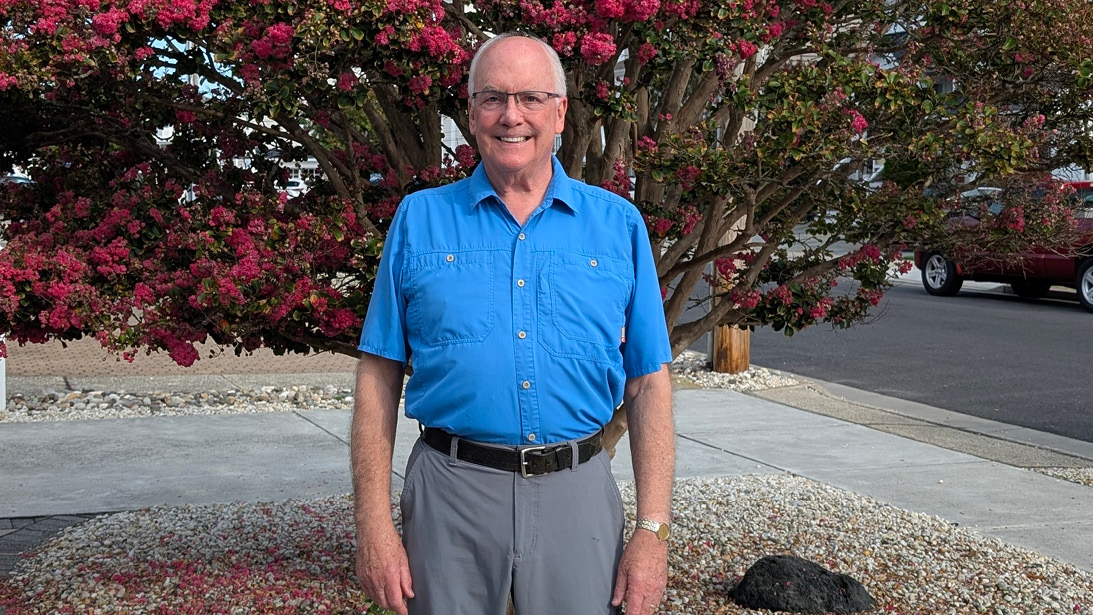
For Richard Lackman, MD, FAAOS, poetry serves as a tool for self-reflection. His poem “The Tree in My Backyard” was inspired by the tree shown here.
Courtesy of Richard Lackman, MD, FAAOS
Published 11/20/2026
Editor’s note: “Outside the OR” is an AAOS Now feature that highlights surgeons’ passions and pursuits beyond the practice of orthopaedics. Through personal stories and unique perspectives, the series offers a glimpse into the lives of surgeons outside the operating room. In this installment, Richard Lackman, MD, FAAOS, discusses how poetry has helped him reflect on a career in orthopaedic oncology. If you have an avocation you’d like to share, contact AAOS Now at aaosnow@aaos.org.
Over four decades as an orthopaedic oncologist, Dr. Lackman experienced successes, setbacks, difficult conversations, and lasting relationships with patients and their families. Writing poetry became a way to process those experiences, preserve important lessons, and maintain perspective.
Dr. Lackman answers questions about poetry, self-reflection, and the stories behind several of his poems.
Why is self-reflection important to you?
Self-reflection has always been important to me, even before I had a name for it. Since our origin as a species, humans have had to endure hardships and challenges. Self-reflection, or the process of thinking deeply about our thoughts, actions, experiences, and decisions, helps us make sense of these challenges. Ideally, this activity will help us maintain our equanimity and improve our effectiveness while optimizing our personal and professional interactions.
This process is not necessarily an easy one to master, as it requires significant concentration to be effective. Writing, be it prose or poetry, helps us organize our thoughts and develop a deeper understanding. Medicine places unique demands on physicians, and without reflection, it can be easy to move from one challenge to the next without fully understanding what those experiences have taught us. Thus, reflective writing has become a common method to improve medical education at all levels.
For me, poetry became one way to slow down and engage in that process. Writing allowed me to revisit important moments, better understand my interactions with patients and families, and maintain perspective throughout my career.
How did you first become interested in poetry?
I’ve long been drawn to poetry, both for its beauty and its ability to communicate important truths in just a few words. Poems such as “Ozymandias” by Percy Bysshe Shelley and “The Road Not Taken” by Robert Frost are clear examples of how a few short lines can help us better understand our interactions with our world.
Over time, I realized that writing poetry could also help me reflect on my own experiences.
How has poetry influenced your career as an orthopaedic oncologist?
During 40 years as an orthopaedic oncologist, I experienced both failures and successes. My ability to put these experiences into poetic form has allowed me to crystallize my thoughts and facilitated my development as a person and a physician.
Several of my poems are included in this article. They give the reader some sense of how I use poetry to clarify my own conception of my career and my interactions with patients and their families. In fact, most of my medical poetry stems from specific patient interactions.
These poems and the messages they communicate have helped me stay grounded and humble in the face of those whose lives I have helped to save and resilient and compassionate in the face of those we could not save.
Your poem “Her Scars Grew Quiet” appears in this collection. What inspired it?
The poem “Her Scars Grew Quiet” expresses the concern we all feel while attempting difficult procedures, yet we accept these challenges for the good of our patients. Our reward is the success that frequently follows.
Her Scars Grew Quiet
The surgery was quite a large endeavor.
Planning a dissection that would sever
Her tumor from the underlying bone.
An action that forever might postpone
Recurrence from this horrible disease,
As a cure we hopefully would seize.
Luckily, all things fell into place.
Finally leaving her without a trace
Of disability as she grew proud,
And scars grew quiet as the years grew loud.
“Childhood Cancer Survivor” has a different focus. What does that poem mean to you?
Orthopaedic oncology often involves caring for patients through some of the most difficult periods of their lives. At the same time, it offers opportunities to witness remarkable resilience.
This poem allowed me to focus on the positive impact my treatment has had on many of my patients and fostered my resilience in the face of these significant diseases.
Childhood Cancer Survivor
I saw her back, now 28 and mother of 2 boys
And yet at our first visit her mom brought along her toys
What miracle had happened that enabled her to live
And now allowed her to go forth with all she has to give
I knew how bravely she approached this horrible disease
Balancing her hopes and fears as if on a trapeze
Suffering in silence, looking older than her age
Amazing that this youngster had the wisdom of a sage
Even on the darkest days she always had a smile
An inner strength to look beyond and always know that while
Life seemed so unpleasant it would hopefully change course
Emanating fortitude from some unknown resource
But now she seemed just quite content with all things as they are
Leaving prior ugliness and pain behind her far
Proud of what she had become more than what she went through
Able to appreciate her world as few can do
I understood this was a moment I was blessed to see
A victory for her more than a victory for me
Communication is a theme in “The Words I Never Said.” Why is that topic important?
The poem reminds me that despite my efforts to be an effective communicator, I need to continue improving in this regard. I would often think of this poem while considering treatments with my patients, and I think this pushed me to further pursue clarity and kindness in these discussions.
The Words I Never Said
As I treated many a bad illness
I would always rail against the stillness
Of quiet thoughts that never were expressed
And kind support that never was addressed.
I did my best to conquer a disease
And bring untold misfortune to its knees.
While always questioning, as well I should
My own success in saying things that would
Disarm the fear that patients always felt
In hopes that their anxiety would melt.
I think I did have some success in this.
And yet I often knew that I did miss
Allaying all their worries and their dread,
As I rehearsed the words I never said
“Worn Stairs” looks back on an earlier period of your training. What inspired it?
This poem was inspired by the stairwells at Pennsylvania Hospital in Philadelphia, where I worked as both a medical student and a resident. The deeply worn marble treads always made me marvel at the number of house staff and physicians who had trod these stairs over many years while caring for patients. The allegory to life was also something I frequently considered.
Worn Stairs
Whenever I observe a flight of stairs
With treads worn thin by years of trudging feet
I cannot help but ponder those who dared
To master all life’s challenges they’d meet
For climbing stairs is like pursuing life
One bit of destiny at each set time
As if it were apportioned by a knife
Or set in some pentameter of rhyme
Each stair requires careful balance still
And strength of heart if we are to ascend
Each stair requires courage and the will
To bring each stage of life a noble end
Yet all who trudge the stairs of life do see
Rewards that come with striving for their cause
And on the stairs they find serenity
From toiling through life’s labors without pause
So like the stairs our lives go up or down
Show majesty or fall to lesser fates
So go trudge up the stairs and find a crown
Or slide down step by step ’til life abates.
Not all of your poetry focuses on medicine. Why was it important to include “The Tree in My Backyard”?
This is an example of how poetry can help us appreciate the beauty around us that we so frequently fail to notice in the course of our daily lives.
The Tree In My Backyard
Each day as I go out I see the tree in my backyard
I think it is a pin oak and its wood is very hard
The tree was here when I moved in about 10 years ago
Since then it got much larger with new branches that did grow
Almost across the whole yard from the west side to the east
Though now that it’s about full grown I think its growing ceased
The tree is like a neighbor whom I’ve known a long, long time
It surely is a beauty and I’m grateful that it’s mine
Sometimes I stand and study it amazed at what I see
I know that it’s alive and wonder if it senses me
The longer I’m around it I think I can tell its mood
And whether it is doing well or needing more plant food.
In spring, it seems a happy tree with leaves of fragile green
In summer, it is fully robed and regal as a queen
In fall its beauty ages as its leaves turn red and brown
In winter, branches cold and still communicate a frown
But most times it seems quite content to spread out in my yard
Not doing more than living which for it seems not too hard
As humans I think there are lessons we can learn from trees
For starters how their splendor seems to put us all at ease
And how they give so much and ask so little in return
Whether sassafras or oak or just a tiny fern
Trees seem to always live their lives with dignity and grace
While changes in the weather they seem always to embrace
They shade the earth and clean the air and never create strife
Showing us what time has taught them to succeed in life
What do you hope readers take away from your poetry?
I hope that these poems encourage readers to find their own method of self-reflection as an aid to happiness and success in their practice and their private life.