

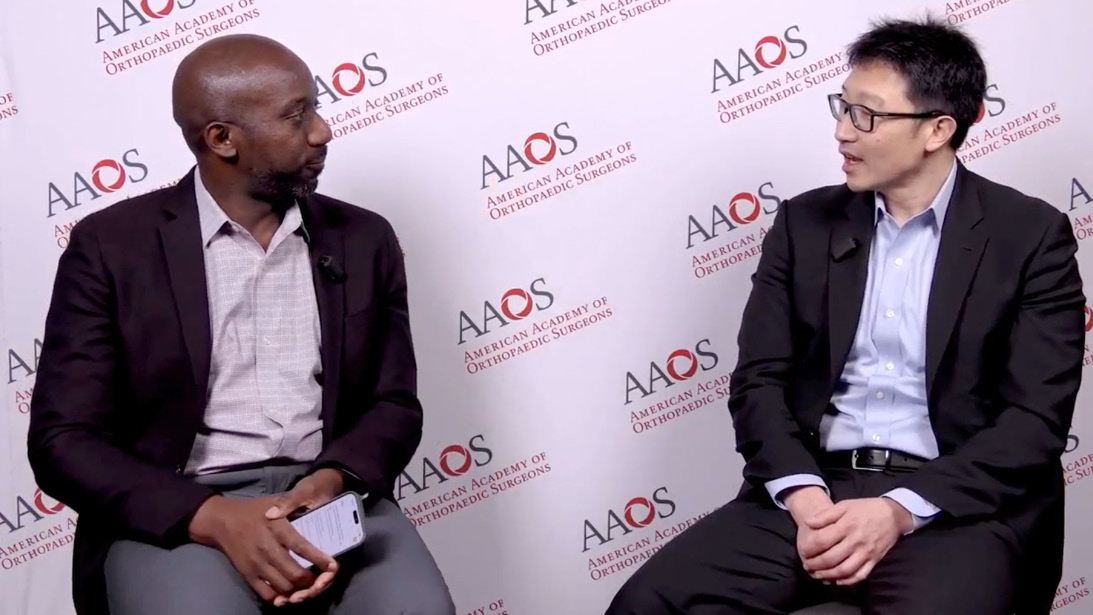
From left: AAOS Now Editorial Board member Odion Binitie, MD, FAAOS, and Tae Won Kim, MD, FAAOS, discuss the potential of using Circulating Tumor DNA in detecting soft-tissue sarcoma.
Published 11/19/2026
|
Theresa Witham
At a Glance
- A personalized circulating tumor DNA assay detected tumor-derived DNA in some patients with soft-tissue sarcoma.
- Circulating tumor DNA levels fell after tumor removal and generally tracked with imaging and disease status.
- Testing remains investigational and should supplement, not replace, routine surveillance imaging.
Estimated reading time: 4 minutes
A personalized blood test that detects fragments of tumor DNA may offer orthopaedic oncologists another tool for monitoring patients with soft-tissue sarcoma, according to findings from a small pilot study presented at the 2026 AAOS Annual Meeting.
Tae Won Kim, MD, FAAOS, associate professor at Cooper Medical School of Rowan University, discussed the study, “Levels of Circulating Tumor DNA Correlate with Disease Status in Patients with Soft Tissue Sarcoma: A Pilot Study,” with AAOS Now Editorial Board member Odion Binitie, MD, FAAOS.
The study examined whether a commercially available circulating tumor DNA (ctDNA) assay could detect tumor-derived DNA in patients with soft-tissue sarcoma and whether ctDNA levels corresponded with disease status. Although ctDNA testing is increasingly used in surgical oncology, Dr. Kim said its utility in orthopaedic oncology is less established.
“We decided, ‘Let’s start with a small pilot study,’” Dr. Kim said. “Just [to answer the] basic question: Can this assay actually detect circulating tumor DNA in patients with soft-tissue sarcomas?”
A personalized marker of disease
As tumors grow, they can shed fragments of DNA into the bloodstream. The Signatera assay used in the study is specific to an individual patient’s tumor. According to Dr. Kim, the assay identifies 16 unique signatures from the tumor and then looks for those specific fragments in the patient's bloodstream.
“That’s what makes it somewhat unique, in that it’s more of a personalized assay,” he said.
The investigators enrolled 21 patients with soft-tissue sarcoma, with follow-up data available for 13 patients at the time of the interview. Approximately 62% of patients had detectable ctDNA at baseline before treatment.
Among patients with positive baseline results, ctDNA levels fell to zero following surgical removal of the tumor. Patients whose levels remained at zero also had MRI and staging studies indicating no evidence of disease.
One case, however, followed a different pattern. A patient who had a particularly high ctDNA level at baseline underwent surgery, but the ctDNA level did not drop to zero. That patient subsequently developed metastatic disease.
“We thought it was a really interesting finding,” Dr. Kim said.
“You also showed [that] the bigger the tumor, the higher the amount of ctDNA,” Dr. Binitie said.
“Size correlated with the baseline [ctDNA] level,” Dr. Kim said, with larger tumors associated with higher levels. Patients who presented with metastatic disease also had higher baseline ctDNA levels.
From pilot study to clinical practice
The early findings have been compelling enough that “we decided that we’re going to draw ctDNA levels for all of our soft-tissue sarcoma patients as part of the practice,” Dr. Kim said.
For now, the blood draws are being performed alongside routine surveillance imaging rather than replacing it. This approach allows the investigators to compare changes in ctDNA with MRI and other staging studies without altering the existing standard of care.
The longer-term question is whether ctDNA could eventually identify recurrent disease before it becomes apparent on routine imaging. Dr. Kim described a potential scenario in which a patient undergoes a standard three- or six-month surveillance scan that shows no evidence of disease, but the patient’s ctDNA level becomes detectable. Such a result could prompt additional imaging, such as a PET scan, to investigate whether recurrent or metastatic disease can be found.
“Can we detect it earlier with a blood draw instead of [an] imaging study?” Dr. Kim asked.
That possibility could make ctDNA particularly useful as a surveillance tool, but considerable uncertainty remains about how individual results should guide patient management.
The trend may matter more than the number
One challenge is determining how clinicians and patients should interpret ctDNA levels, particularly because there is not yet a threshold to separate reassuring from concerning results in patients with soft-tissue sarcoma.
“I can’t tell you what’s a good or bad number,” Dr. Kim said. “There’s no threshold that we can say right now.”
Instead, he said, the patient's trend over time may prove more informative than an individual value. Experience with ctDNA in other areas of surgical oncology suggests that persistently detectable or rising levels may have prognostic implications.
The testing also introduces the potential for patient anxiety. Because patients receive their results,some of them contactDr. Kim’s office to ask what a particular ctDNA value means. Without validated thresholds or clear clinical algorithms, explaining those numbers can be challenging.
Those unanswered questions underscore the preliminary nature of the findings. The current study is small, and the role of ctDNA in soft-tissue sarcoma surveillance will require further investigation before clinicians can determine how changes in ctDNA should influence imaging or treatment decisions.
Still, Dr. Kim sees the potential for a future in which ctDNA testing plays a much larger role in surveillance. Rather than routinely performing imaging at predetermined intervals, clinicians might someday monitor patients through serial blood testing and obtain imaging when ctDNA becomes detectable or begins to rise.
Replacing routine MRI with blood-based surveillance, however, would represent a major change in practice.
“It’s going to be a hard jump;it’s going to be a big leap,” Dr. Kim said. “But I do think that there is potential for this to be a surveillance mechanism.”
For now, imaging remains central to follow-up. But if larger studies validate the relationship between ctDNA and disease status, a personalized blood test could eventually provide orthopaedic oncologists with an additional means of identifying disease recurrence and deciding when further evaluation is warranted.
Theresa Witham is managing editor of AAOS Now.