

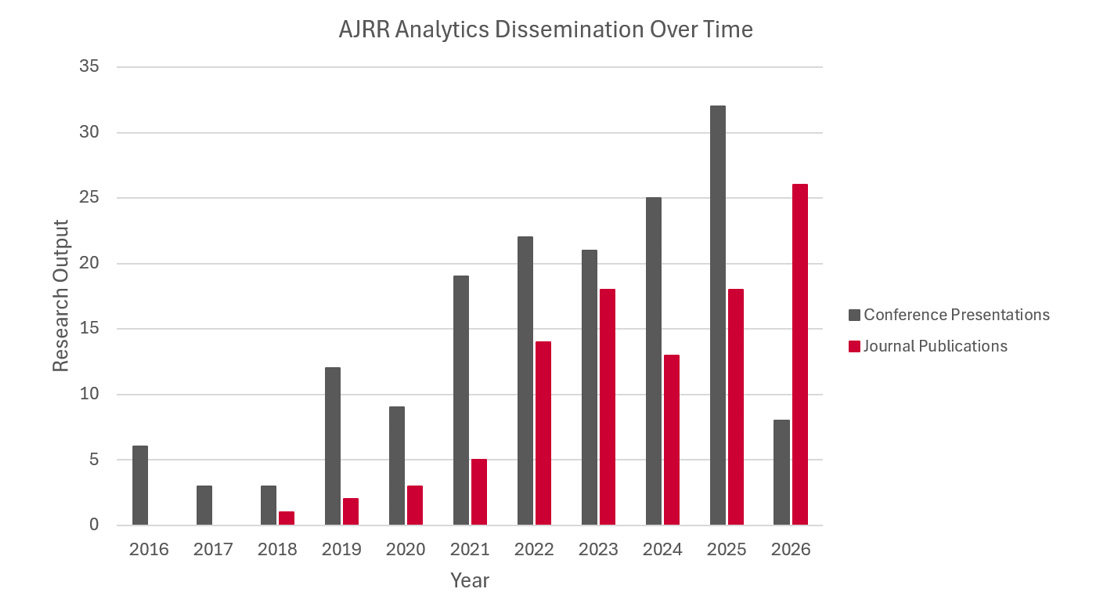
AJRR and RAI research dissemination has accelerated in recent years, resulting in increasing numbers of conference presentations and peer-reviewed publications. The trend highlights the growing contribution of registry-based research to orthopaedic knowledge and clinical decision making.
Courtesy of AAOS Registry Program.
Published 11/19/2026
|
Jennifer Lefkowitz
At a Glance
- AJRR published its 100th peer-reviewed study.
- RAI is approaching its 100th research project.
- Registry data continue to inform arthroplasty outcomes and practice.
Estimated reading time: 4 minutes
AJRR and RAI research dissemination has accelerated in recent years, resulting in increasing numbers of conference presentations and peer-reviewed publications. The trend highlights the growing contribution of registry-based research to orthopaedic knowledge and clinical decision making.
Courtesy of AAOS Registry Program.

Vishal Hegde, MD, FAAOS

Richard L. Illgen II, MD, FAAOS
Data from the American Joint Replacement Registry (AJRR), with analysis by the Registry Analytics Institute (RAI), helps researchers gain key insights into the value and potential of hip and knee arthroplasty procedures. As the RAI nears completion of its 100th research project, the AJRR has released its 100th peer-reviewed publication, milestones that underscore the growing value of this partnership in identifying trends, evaluating outcomes, and improving patient care.
Now the world’s largest national registry of hip and knee arthroplasty surgeries, the AJRR draws on data from more than 5 million procedures. The size and breadth of the registry make it a powerful resource for improving orthopaedic practice and patient care.
“With numbers like this, we can conduct sophisticated statistical analyses to address clinically relevant questions across patient populations and identify what’s working, what’s not, and the factors that contribute to patient-reported outcomes,” said Richard L. Illgen II, MD, FAAOS, chair of the Research Projects Subcommittee and vice chair of the AJRR Steering Committee.
Dr. Illgen described the RAI as the “research arm” of the AJRR, providing a structured pathway for investigators to explore hypothesis-driven research questions.
“Research proposals are submitted in an NIH-like fashion,” he explained. “The process is blinded, and a team reviews the applications to decide which projects will be supported.”
The impact extends well beyond the 100 research projects completed to date. Since its inception in 2019, the RAI has produced 160 podium and poster presentations in addition to 100 peer-reviewed manuscripts (Figure 1) that have garnered 1,200-plus citations. Together, these achievements reflect the RAI’s emergence as a trusted source of evidence for sound clinical decision making that improves joint replacement care.
---
Related Content
- AAOS Registry Analytics Institute® Powers Orthopaedic Discovery through Registry Science (AAOS Now)
- Registry Analytics Institute (AAOS)
- American Joint Replacement Registry (AAOS)
- AJRR Data in Practice (AAOS)
---
Registry data answer clinically relevant questions
Vishal Hegde, MD, FAAOS, an orthopaedic surgeon who has been involved with the RAI since 2022, said the Institute extends the value of AJRR.
“The AJRR and the RAI are our view into how the United States is progressing in hip and knee replacement,” Dr. Hegde said. “These data tell us about the implants surgeons are using, the adoption of new approaches and technologies, and, ultimately, whether those changes are improving patient outcomes. As orthopaedic surgeons, it is critical to understand what we are doing and if it is helping patients.”
Dr. Hegde witnessed these benefits firsthand when his RAI study compared outcomes of mobile-bearing total knee arthroplasty with fixed-bearing procedures. Using AJRR data, his research team found that mobile-bearing arthroplasty had a higher failure rate with increased revision risks due to tibial component design, balance complexity, and bearing dislocation.
These key findings earned him the American Association of Hip and Knee Surgeons’ (AAHKS) James A. Rand, MD, Young Investigator Award in 2022. Dr. Hegde credits the quality of the RAI research for gathering evidence that improves patient outcomes and informs best clinical practices.
Discoveries like these go beyond clinical decisions. Research from AJRR can help hospitals benchmark quality, provide clinical evidence on how implants and technologies perform in the real world, and spark broader discussions about quality measurement and healthcare policy by evaluating patient-reported outcome measures across large patient populations.
How clinical questions become research findings
For investigators who want to conduct research in partnership with the RAI, Dr. Illgen recommends reviewing published and ongoing RAI projects and becoming familiar with AJRR data elements, capture rates, and limitations.
“Understand what the registry data can and cannot do,” he advised. “Look at the previous 100 published papers as well as the projects currently in the pipeline so you’re not asking a question that has already been raised.”
Understanding the available data is crucial when designing studies of revision procedures. Because the AJRR now captures approximately half of hip and knee arthroplasty procedures performed in the U.S., a patient’s primary procedure could be recorded there, while a subsequent revision at a non-participating institution might not. Linking AJRR data with Centers for Medicare & Medicaid Services (CMS) data helps researchers capture follow-up procedures among Medicare patients, providing a more complete picture of revision outcomes.
“If you want to do an outcome study related to revision or redo operations, you need to limit your study to patients over the age of 65,” Dr. Illgen explained.
AJRR expands opportunities for high-impact research
As the AJRR has grown, so have the research questions investigators can pursue.
“The registry grows more and more sophisticated every year, especially with the integration of CMS data,” Dr. Hegde said. “The level and duration of follow-up we have, the level of comorbidities we can see, continues to improve.”
Dr. Hegde also explained that based on feedback, the RAI refined its application cycles to better align with the needs of resident and fellow researchers. The fall application cycle allows researchers to receive data by the following spring, providing time to develop abstracts for submission to the AAOS and AAHKS annual meetings.
The AJRR and the RAI are also focused on the future, piloting complex research methodologies such as registry-nested randomized controlled trials. For Dr. Hegde, these advances signal that recent milestones are just the beginning of what the RAI can achieve.
“We are just scratching the surface of the power of this registry,” he said. “Our capabilities are expanding, so our impact will only grow from here.”
To learn more about the RAI and the research application process, visit https://www.aaos.org/registries/registry-analytics-institute/.
Jennifer Lefkowitz is a freelance writer for AAOS Now.