

Persistent pain after total hip arthroplasty can arise from numerous sources, including infection, soft tissue disorders, implant-related complications, and pathology outside the hip joint itself.
Published 10/20/2026
|
Stuart Hales
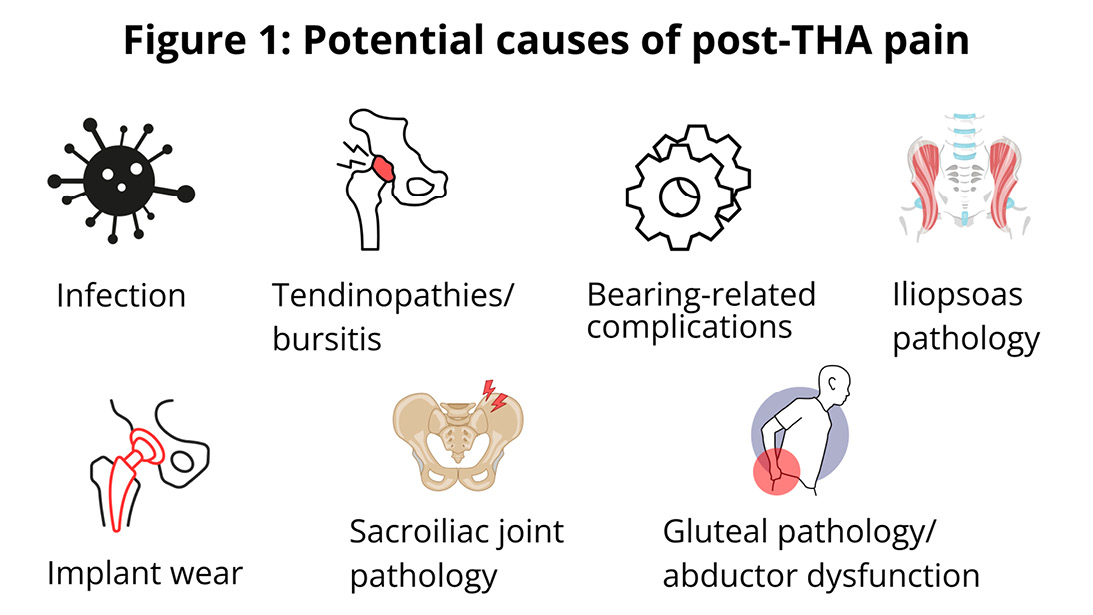
As total hip arthroplasty (THA) has become one of the most common surgical procedures in the United States, it has also become more effective, with many patients enjoying years of pain-free motion. Patients who report post-THA pain (Figure 1) challenge not only the medical skills of orthopaedic surgeons but also their sleuthing abilities and often requires looking beyond the implant itself, according to presenters at the “Maybe It Was Never the Hip Joint,” Instructional Course Lecture at the AAOS 2026 Annual Meeting in New Orleans.
“The workup of the painful total hip replacement is detective work,” said Lee E. Rubin, MD, FAAOS, FAOA, professor of orthopaedics and rehabilitation and section chief in the Division of Hip & Knee Joint Reconstruction at the Yale School of Medicine. “The art of diagnosis becomes paramount. It’s a little bit like ‘The Adventures of Sherlock Holmes.’”
Persistent pain after total hip arthroplasty can arise from numerous sources, including infection, soft tissue disorders, implant-related complications, and pathology outside the hip joint itself.
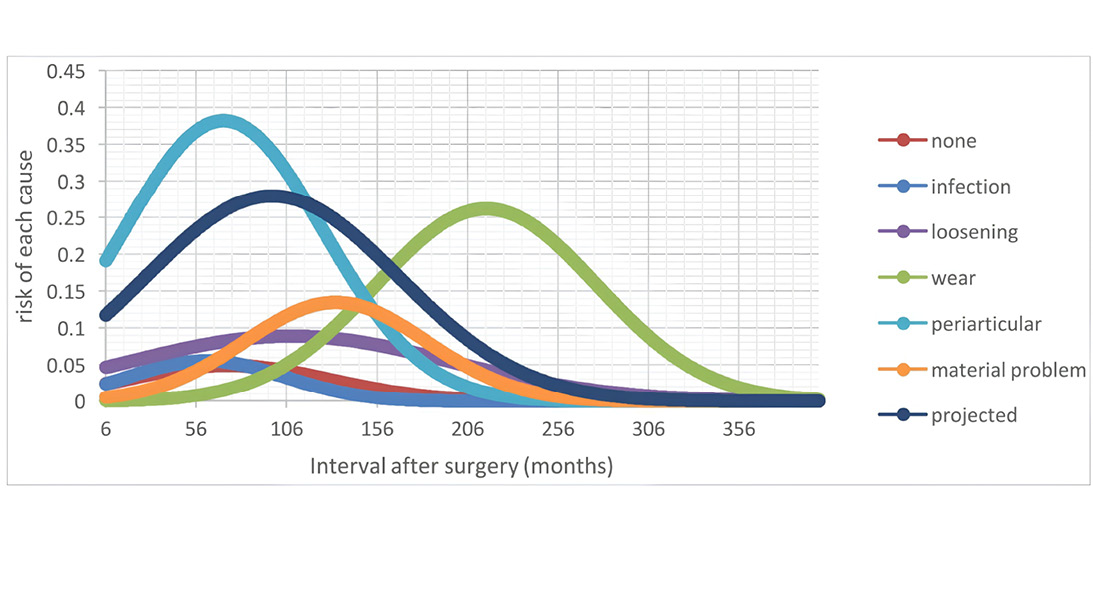
Figure 2: Emergence of each frequent cause of painful hip arthroplasty Caption: Causes of pain after total hip arthroplasty vary by time from surgery. Periarticular conditions predominate during the first 10 years, whereas implant wear becomes more common later.
Courtesy of Lee E. Rubin, MD, FAAOS, FAOA
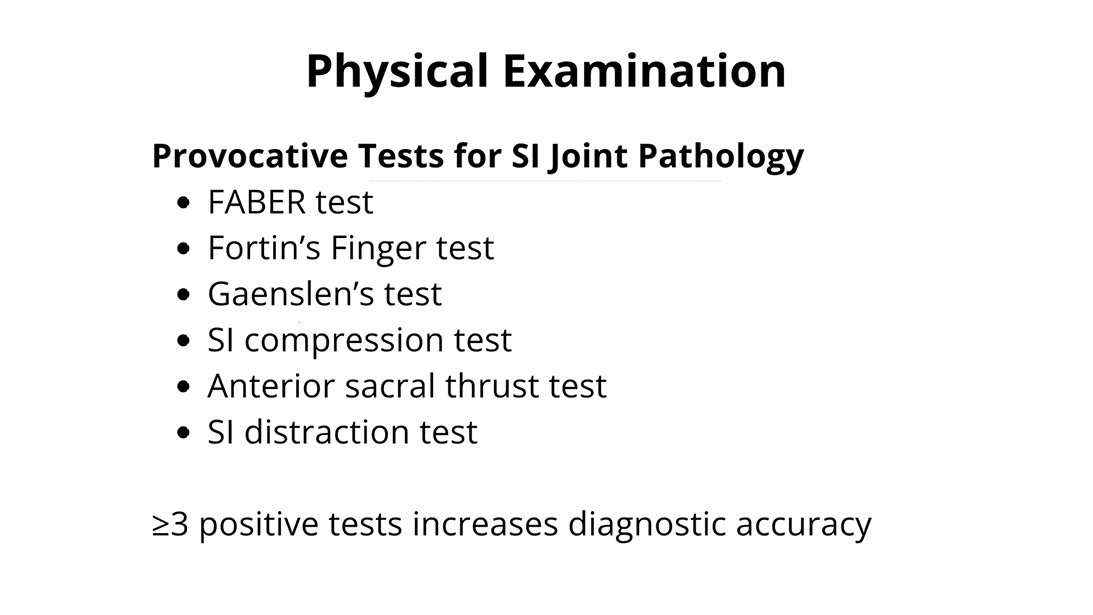
Figure 3: Physical examination in the evaluation of sacroiliac joint pain includes several provocative maneuvers.
Courtesy of Alisina Shahi MD, PhD

Etan Sugarman, MD, FAAOS, director of joint preservation at the American Hip Institute, addressed pain issues stemming from the lateral side of the hip, specifically global offset gluteal pathology and abductor dysfunction after total hip arthroplasty.

Attendees pay close attention during the “Maybe It Was Never the Hip Joint,” ICL session at the AAOS 2026 Annual Meeting in New Orleans.
Perhaps the best place to start the investigation, Dr. Rubin suggested, is by looking for evidence of infection. “All painful hips should have a workup for infection,” he said. “They’re infected until proven otherwise.”
Citing a 2019 study in the Journal of Arthroplasty that examined painful hips in nearly 200 patients (Figure 2), Dr. Rubin noted that periarticular issues such as tendinopathies and bursitis account for the bulk of patients who present with pain within the first 10 years after THA surgery, while wear is primarily responsible for those who present 10 to 20 years later.
“In the middle are the material problems, the orange curve,” he said. “Those don’t tend to happen right away, but they also don’t tend to wait 10 years. They can evolve over a few years. So you have to really figure this out.”
Dr. Rubin presented five case studies illustrating different post-THA complications, including that of a 56-year-old woman who had undergone THA surgery followed by multiple dislocations and revisions.
“We figured the bearing was the issue,” he explained. “Just moving the hip a little bit, it [the instability] didn’t look bad. She’s moving around, and you’re sitting there thinking, ‘What am I doing in this? Why am I here?’”
The solution to this case lay in the patient’s lifestyle — she was a yoga practitioner. “She’s very flexible, hypermobile, and when we put her in more extreme positions of rotation, we could see the liner had dislocated,” he said.
The takeaway from the five cases, Dr. Rubin said, is to take a broad diagnostic approach. “People will present, and you will think there’s nothing wrong, but there is something wrong,” he said. “It’s your job as the hip revision specialist in your community to figure out what that is.”
Benjamin G. Domb, MD, FAAOS, medical director at the American Hip Institute (AHI) and chair of the AHI Research Foundation, took a narrower perspective than Dr. Rubin by focusing on a specific source of post-THA pain — the iliopsoas.
The test for an iliopsoas complication, he noted, is an iliopsoas injection with ultrasound guidance. “If that gives temporary pain relief — and I’d emphasize temporary — then that is effectively a diagnosis,” he said. “I want to see if they have relief in the 30 minutes after the injection, when the lidocaine is in effect.”
Dr. Domb presented the case of a 51-year-old woman who had slipped on ice. She had undergone a hip arthroscopy, then a revision hip arthroscopy and ultimately a hip replacement. After a diagnostic workup, Dr. Domb performed a fractional lengthening of the iliopsoas, which was crossing directly over the collar of the stem.
“Two weeks postoperatively, her pain was completely gone,” Dr. Domb said. “She was pain-free on a stationary bike, and at five years’ follow-up, she continued to have no return of pain.”
In Dr. Domb’s view, the relative simplicity of an iliopsoas tenotomy and its lower complication rates make it an attractive alternative to a THA revision.
“If I have an opportunity in my own hip to be treated with a 20-minute endoscopic procedure with minimal risk of infection or dislocation, I would rather start there and reserve the nuclear bomb of revision arthroplasty for a last resort,” he said.
Check for abduction strength
Etan Sugarman, MD, FAAOS, director of joint preservation at AHI, addressed pain issues stemming from the lateral side of the hip, specifically global offset gluteal pathology and abductor dysfunction after total hip arthroplasty.
“Do [your patients] have trochanter tenderness?” he asked. “Lie them on their side and look at their abduction strength. Most patients who are painful or weak will have a tendency to externally rotate their pelvis so they can recruit their hip flexors as their abductors. You really have to make sure they are lying on their side, that their pelvis is really in that lateral position and what they’re firing is truly their abductors and not recruiting their TFL and hip flexors more anteriorly.”
As for treatment options, Dr. Sugarman cautioned against relying heavily on steroids.
“I think there’s increasing awareness, certainly over the last seven to eight years or so, about the detrimental effects of cortisone,” he said. “So, when we have patients that come in that have had five, six, seven corticosteroid injections to their gluteal tendon, you have to be a little bit more concerned that perhaps there’s some underlying anatomic issue that has not been resolved. It’s not just inflammation, but also keep in mind that the quality of the tendon may have been adversely affected from those steroid injections.”
Resolving overlapping symptoms
Alisina Shahi, MD, PhD, assistant professor of orthopaedic surgery at McGovern Medical School at the University of Texas Health Science Center in Houston, addressed posterior pathology, focusing specifically on pain emanating from the sacroiliac (SI) joint. Noting that studies suggest up to 30% of chronic low back pain may originate from the SI joint, he said the diagnosis can be challenging because the symptoms often overlap with hip and spine pathology.
“The SI joint plays an important biomechanical role — it connects the spine to the pelvis and transmits forces between the axial skeleton and lower extremity,” he said. “Why SI joint pain can occur after total hip replacement is mainly because THA alters the biomechanics of the hip-spine-pelvis complex. Changes in pelvic motion and alignment can increase the stress across the SI joint, and it is hypothesized that the pain is mostly generated from ligamentous and capsular tension, extraneous compression across the joint, or shear forces.”
Dr. Shahi noted there are several “provocative maneuvers” that can stress the SI joint and assist with the diagnosis, including the FABER test, Fortin’s finger test, and Gaenslen’s test (Figure 3).
“There is no single test that can have 100% accuracy, sensitivity, and specificity,” he explained. “Therefore, we need to use a battery of tests, and the literature suggests that if you have more than three positive provocative tests, it is highly likely that the pain is coming from the SI joint.”
Ultimately, the speakers encouraged surgeons to approach the painful THA much like a detective approaches a complex case: start with a broad differential diagnosis, follow the evidence, and remain open to explanations that extend beyond the hip joint itself.
Stuart Hales is a freelance writer for AAOS Now.
References
- Dreyfuss P, Dreyer SJ, Cole A, Mayo K. 2004. Sacroiliac joint pain. J Am Acad Orthop Surg. 2024;12(4):255-265.
- Erivan R, Villatte G, Ollivier M, and Paprosky WG. Painful hip arthroplasty: what should we find? diagnostic approach and results. J Arthroplasty. 2019;(34):1802-1807.
- Fitzpatrick J, Bulsara M, O’Donnell J, and Zheng MH. 2019. Leucocyte-rich platelet-rich plasma treatment of gluteus medius and minimus tendinopathy: a double-blind randomized controlled trial with 2-year follow-up. Am J Sports Med. 2019;47(5):1130-1137.