

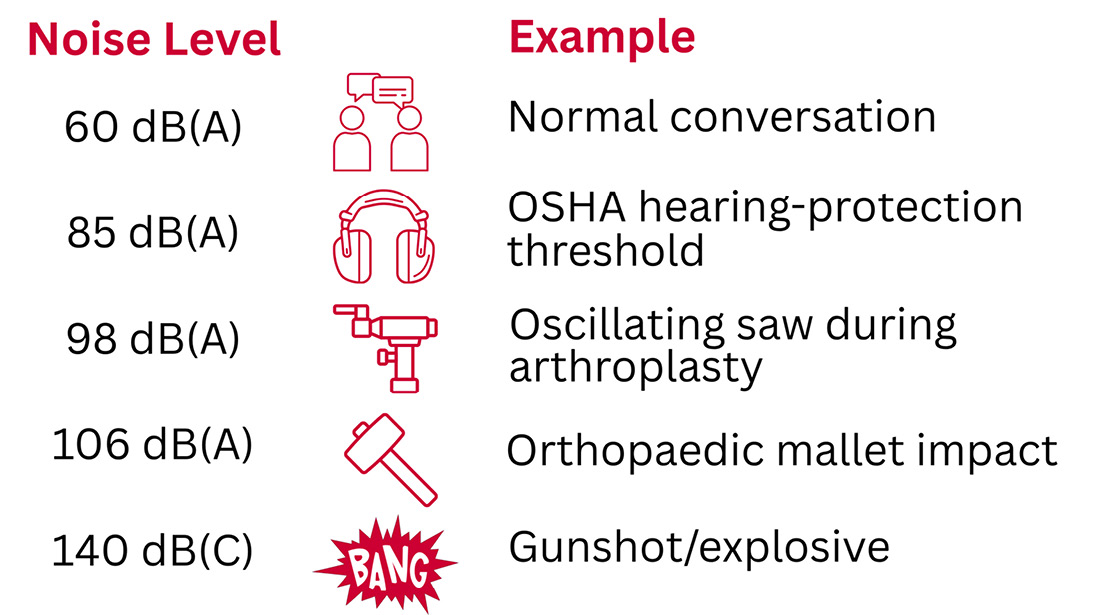
Figure 1: How loud is the orthopaedic operating room? Noise levels generated by common orthopaedic instruments can meet or exceed recommended occupational exposure thresholds. Understanding these reference points may help surgeons recognize when hearing protection is warranted.
Published 10/20/2026
|
Enrique Vazquez; Lauren M. Shapiro, MD, MS
At a Glance
- Orthopaedic ORs frequently exceed recommended workplace noise thresholds.
- Repeated exposure may contribute to cumulative hearing loss and tinnitus.
- Filtered earplugs, audiometric testing, and equipment choices can reduce risk.
Estimated read time: 5 minutes
Editor’s note: This article is the third in a three-part series examining key occupational hazards in orthopaedics, with the goal of increasing awareness and promoting safer clinical environments.
Figure 1: How loud is the orthopaedic operating room? Noise levels generated by common orthopaedic instruments can meet or exceed recommended occupational exposure thresholds. Understanding these reference points may help surgeons recognize when hearing protection is warranted.
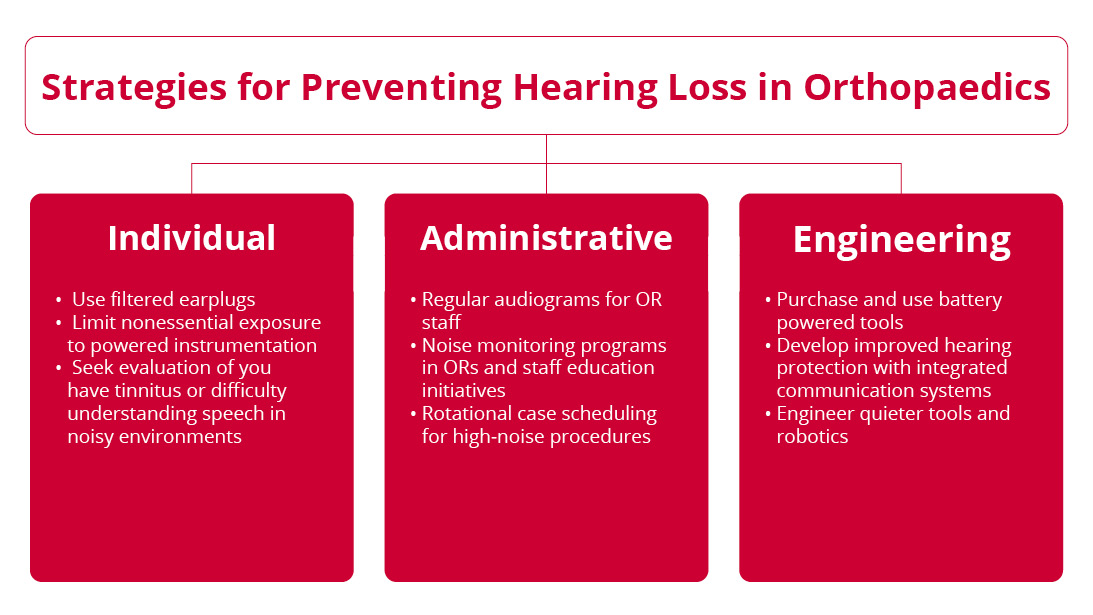
Figure 2: Strategies for preventing hearing loss in orthopaedics Individual, administrative, and engineering interventions may help reduce cumulative noise exposure in the operating room. Examples include filtered earplugs, routine audiometric testing, hearing-conservation programs, and quieter surgical equipment.
Courtesy of Enrique Vazquez and Lauren M. Shapiro, MS, MD
Orthopaedic surgeons are accustomed to thinking about occupational hazards: radiation exposure, sharps injuries, and physical strain are all fixtures of safety culture. Yet, even amidst mounting evidence of risk, the dangers of noise-induced hearing loss are underrecognized in the field.
Orthopaedics is one of the loudest surgical subspecialties. Surgeons routinely operate with saws, mallets, and reamers — exposure to which can result in cumulative and irreversible hearing loss. However, because tool use is brief and episodic, the long-term impact on hearing is often overlooked. By using prevention strategies to minimize damage, surgeons and others in the orthopaedic healthcare system can protect themselves from this not-so-silent threat.
A growing body of evidence demonstrates the risks
Occupational Safety and Health Administration (OSHA) standards state that workers exposed to daily noise levels averaging 85 A-weighted decibels (dB[A]) or higher must have ear protection made available to them to mitigate the risk of permanent hearing damage (Figure 1).
Unfortunately, multiple studies have documented that orthopaedic operating rooms (ORs) often surpass these levels. A systematic review published in 2026 by Powell et al. examined 17 studies measuring intraoperative noise, 11 of which reported procedures exceeding 85 dB(A). Two studies recorded peak noise levels above 140 dB(C), indicating exposure to extremely loud, high-intensity sounds comparable to a gunshot or explosion.
---
Related Content
- Female orthopaedic surgeons face unique breast cancer risks (AAOS Now)
- Orthopaedic practice comes with chemical hazards (AAOS Now)
---
Exposure to such noise levels and the risk of hearing loss are not evenly distributed across orthopaedics. Surgeons in arthroplasty, trauma, and spine — those who rely heavily on loud cutting and drilling techniques — are at greatest risk. A 2021 investigation by Palmer et al. demonstrated that surgeons who conducted total hip and knee arthroplasty surgery had 3.7 times greater odds of failing a hearing test compared to nonsurgical clinicians. In this investigation, 31% of surgeons screened positive for hearing loss. Both cohorts (surgical and nonsurgical) were of similar age (averaging 49 years), with hearing loss models being adjusted for age, gender, smoking status, and additional noise exposures. Similarly, a 2017 paper by Simpson et al. demonstrated that the hammers and oscillating saws frequently used in total knee and hip arthroplasties reached volumes of 105.6 dB(A) and 97.9 dB(A), respectively, with every case observed exceeding volumes of 90 dB.
How damage occurs in the OR
In a healthy individual, environmental sound is internalized by vibration of the ear’s tympanic membrane. The membrane creates a fluid wave that passes to the inner ear, bending tiny hair-like projections, called stereocilia, on our cochlear hair cells. This process converts mechanical energy into an electrical signal transmitted through the auditory nerve to the brain.
Noise-induced hearing loss occurs through mechanical and metabolic injury to this pathway. When exposed to loud sounds, the stereocilia bend farther than they are meant to, physically straining the structures. Similarly, excessive stimulation of hair cells increases their metabolic demand, resulting in oxidative stress and excitotoxic injury at nerve synapses. Both mechanisms can lead to cell dysfunction and death.
Since mammalian cochlear hair cells do not meaningfully regenerate, injury accumulates over time. Noise injury can gradually manifest as subtle dysfunction, such as tinnitus (ringing in ears) or difficulty discriminating sounds in loud environments, before progressing to high-frequency hearing loss and permanent threshold shifts. Early damage may not be obvious to a surgeon, and if it is, they may attribute hearing challenges to aging rather than occupational exposure.
“People often only notice damage after there’s been a functional change, or when they develop new symptoms like tinnitus or aural fullness,” says Nicole Jiam, MD, an otologist and neurotologist at the University of California – San Francisco. “The early changes can be subtle, which makes the risk easy to overlook.”
Given the complexity of noise exposure in the OR, it is often hard for surgeons to know when damage occurrs. While sounds like background music or patient vital monitors are constant, episodic noises pose the greatest threat. Power tools generate bursts of sound that can overstimulate hair cells to cause metabolic damage, and the energy-dense peaks of mallet strikes mechanically alter the stereocilia. These noises may seem brief enough to be tolerable, but the repeated burden across days, years, and decades results in substantive harm. As Dr. Jiam notes, “We know that occupational noise exposure exceeding 10 years is associated with nearly sevenfold higher odds of hearing loss.”
Prevention strategies to reduce surgeon hearing loss
Recognizing the auditory risks surgeons face in the OR, and acknowledging that those risks can be mitigated, is the first step toward addressing noise-induced hearing loss. From there, several preventive strategies, ranging from individual behavior to institutional practice, are available (Figure 2).
One practical and immediate solution surgeons can implement is to wear filtered earplugs. Like those worn by musicians or construction workers, these low-profile devices are custom molded to the user’s ear canal and utilize filters that attenuate damaging frequencies while still preserving speech perception. Powell et al. reviewed studies comparing custom-molded earplugs, surgical hood systems, and active noise-cancelling headphones, finding that filtered earplugs offered the most consistent noise reduction while preserving communication.
At the institutional level, hospitals could conduct baseline and routine audiometric testing, which the National Institute for Occupational Safety and Health (NIOSH) recommends orthopaedic surgeons undergo annually. Hospitals may also choose to preferentially order specific tools. In a 2013 study, Udeh et al. compared sound levels generated by battery-powered orthopaedic instruments with pneumatic and cord-powered devices and demonstrated that battery-powered tools produced lower noise levels. Such findings could inform hospital purchasing decisions when replacing surgical equipment.
Administrators may also consider hearing conservation programs for staff who engage in high-risk surgeries. Although not yet well studied in orthopaedic surgery and challenging given the specialized skill sets required for certain procedures, noise-safe job-rotation models are used by other industries with occupational noise exposure. For instance, Tharmmaphornphilas et al. demonstrated that schedules rotating sawmill workers across tasks with different noise levels reduced maximum daily noise dose by 58.8%.
Despite these recommendations, the burden of noise-induced hearing loss in orthopaedic surgery, and its most effective solutions, are largely understudied. Conducting longitudinal research on surgeon hearing or procedure-specific exposure may help clarify risk and improve harm reduction approaches. There are also multiple opportunities to develop improved hearing protection with integrated communication systems or engineer new tools and robotic technologies that minimize noise exposure.
However, the most consequential approaches to risk mitigation may depend less on equipment and more on culture. Encouraging surgeons to trial filtered ear protection or undergo audiometric testing can shift hearing awareness from an individual preference to a professional norm. Similarly, discussing concerns about noise exposure with administrative staff may result in new protocols that protect surgeons and their teams for years to come. Such changes may seem small, but together they signal that hearing protection belongs in conversations on surgical safety. As practicing orthopaedic surgery carries real risks of hearing loss, the only question is whether we’ll listen to the warning signs.
Enrique Vazquez is a medical student at the University of California – San Francisco School of Medicine. Lauren M. Shapiro, MD, MS, is an associate professor in residence of orthopaedic surgery at the University of California – San Francisco.
References
- Powell CJ, Huang AY, Cyrus J, et al. Noise levels and noise-induced hearing loss in the orthopaedic operating room: a systematic review. JBJS Open Access. Jan-Mar 2026;11(1)doi:10.2106/jbjs.Oa.25.00276
- Palmer JS, Wilson C, Fraig H, Wilson D, Garrett S. Hearing evaluation of arthroplasty surgeons: results from the HEARS study. Ann R Coll Surg Engl. Oct 2021;103(9):673-677. doi:10.1308/rcsann.2021.0050
- Simpson JP, Hamer AJ. How noisy are total knee and hip replacements? J Perioper Pract. Dec 2017;27(12):292-295. doi:10.1177/175045891702701204
- Broadwater KR, Brueck SE. Evaluation of a Surgical staff’s noise exposures during total knee replacement surgeries. Cincinnati, OH: US Department of Health and Human Services, Public Health Service, Centers for Disease Control and Prevention, National Institute for Occupational Safety and Health, HHE 2014-0154-3275, 2017 Mar. 03/01 2017;Health Hazard Evaluation Reports (HHE). doi:10.26616/NIOSHHHE201401543275
- Udeh H, Lui DF, Repede A, O’Grady P, Hughes B, Bennett D. Occupational noise levels in modern battery operated and conventional orthopaedic surgical devices. Current Orthopaedic Practice. 2013;24(4):420-423. doi:10.1097/BCO.0b013e3182986f04
- Tharmmaphornphilas W, Green B, Carnahan BJ, Norman BA. Applying mathematical modeling to create job rotation schedules for minimizing occupational noise exposure. AIHA Journal. 2003/05/01 2003;64(3):401-405. doi:10.1080/15428110308984833