


Gary W. Herschman, JD, addresses attendees during the Instructional Course Lecture “e-Business of Orthopaedics – What’s Going on and Why? Solutions for Survival, Merging, or Staying the Course” at the AAOS 2026 Annual Meeting.
Published 10/20/2026
|
Leah Lawrence
At a Glance
- Orthopaedic practices have multiple options beyond remaining independent or selling to a hospital.
- Private equity, health systems, family offices, and physician-led mergers each offer distinct advantages and risks.
- Culture, recruitment, and long-term financial stability should guide partnership decisions.
Estimated read time: 4 minutes
Orthopaedic practices continue to face financial challenges as Medicare reimbursement rates decrease and the cost of doing business increases. Faced with these constraints, many orthopaedic groups are navigating possibilities related to consolidation, acquisitions, partnerships, and more.
During the 2026 AAOS Annual Meeting, two business insiders gave attendees some insight into these trends during the Instructional Course Lecture, “e-Business of Orthopaedics – What’s Going on and Why? Solutions for Survival, Merging, or Staying the Course.”
“When we talk to doctors around the country in the orthopaedics space, 2025 was pretty slow for mergers, for a variety of reasons,” said Dana Jacoby, MBA, president and CEO at Vector Medical Group. “Interestingly, 2026 is no less uncertain [than 2025], but a lot of our groups are struggling with reimbursement cuts. We see a lot more groups at the table that want to find a partner than we did this time last year.”
Gary W. Herschman, JD, addresses attendees during the Instructional Course Lecture “e-Business of Orthopaedics – What’s Going on and Why? Solutions for Survival, Merging, or Staying the Course” at the AAOS 2026 Annual Meeting.
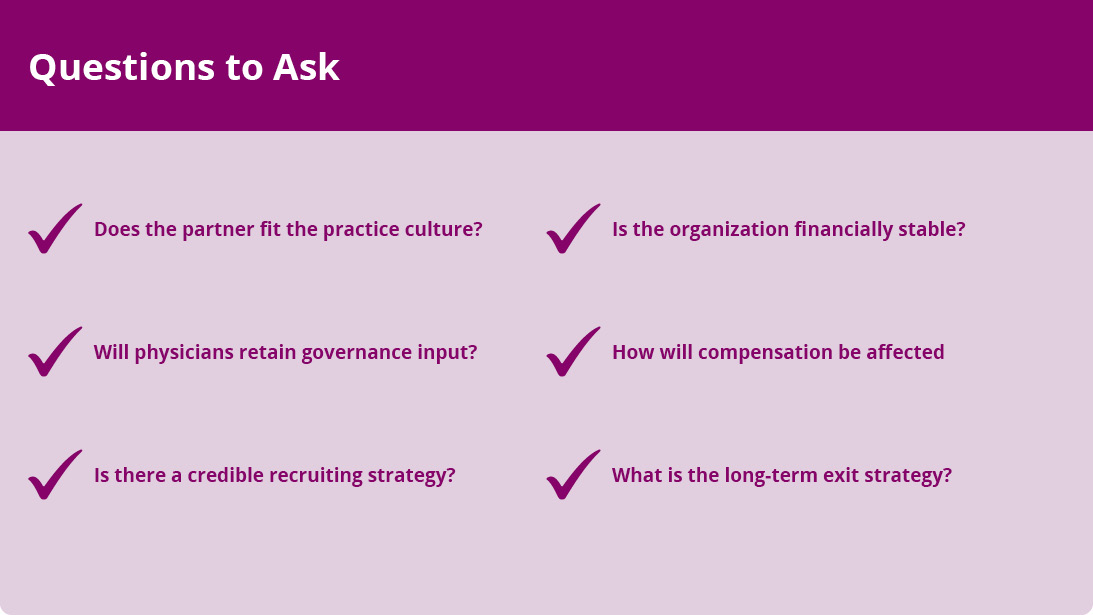
Figure 1: Decision Points Before Choosing a Partner Caption: Orthopaedic practices should assess culture, governance, recruiting capability, financial strength, compensation impact, and long-term strategy when considering a partnership.
Indeed, the orthopaedic sector remains well positioned for continued investment due to its scale, fragmentation, and value creation potential, Jacoby said.
Strategic options
Jacoby was joined by Gary W. Herschman, JD, a healthcare transaction partner at law firm Baker Donaldson, who detailed 10 strategic options for physician practices to consider in the current market.
1. The first option is a transaction with a reputable private equity-funded practice management platform with a track record of success in the specialty.
“With private equity platforms there are clear pros and cons,” Herschman said. “They are not all successful, but based on our experience, I would say 80% to 90% are successful in that they don’t interfere with clinical care and are an overall ‘positive’ for the doctors.”
Herschman emphasized that anyone considering private equity must do their due diligence on potential partners. This increases the likelihood of success.
2. A second option is to transact with a practice management platform backed by a reputable family office — a private investment entity that manages wealth on behalf of a family — with a track record of success with physicians.
“A good part about partnering with a family office is they are basically just investing in the existing team of physicians,” Herschman said. They generally do not have a short-term philosophy of “build and leave” and may remain invested for 10 years or longer.
3. A third option is selling the practice to, and becoming employed by, a local hospital or health system. Trust in local hospitals and health systems varies by region and institution, Herschman said. If considering this option, explore important aspects like what happens upon changes to hospital leadership and figure out how to guard against the slow erosion of clinical governance that could occur over time.
4. Another option for orthopaedic practices is a hybrid approach of joining a reputable three-way partnership with a health system and a private equity investor.
5. Additionally, practices can merge into a 100% physician-owned specialty practice or multi-specialty practice in the region.
“This option is not new at all, as medical groups in certain regions have been merging for many years to create larger organizations,” Herschman said. “The biggest drawback of this option is that you still need capital to grow and succeed, and physician owners must bring the capital directly or indirectly through debt.”
6. A sale to a payer-sponsored provider is another option. Payer-owned medical groups have become very large players in physician group acquisition/consolidation over the last 20 years. One major example is Optum, which Herschman said employs nearly 100,000 physicians.
“They have the infrastructure to help with data analytics and value-based care,” he said, “but it seems like most doctors don’t want to be employed by a payer.”
7. Practices can also choose to contract with a reputable specialty management services organization. This serves as a contract for seasoned management expertise and is not a sale of practice, Herschman noted.
8. Another option that does not require sale of practice is entering into a professional services agreement (PSA) with a hospital system. In this scenario, the practice continues to employ its physicians and other licensed clinicians. The physician group remains a separate entity and can terminate the PSA.
9. Employee stock ownership plans (ESOPs) are an option that works best for larger groups with substantial corporate infrastructure and a seasoned executive team. With this option, all employees have ownership, which vests over time. Upon retirement or departure, the shares typically are repurchased by the ESOP according to the terms of the plan.
10. If none of these other options is appealing, remaining independent may be the best pathway, Jacoby said.
“We have seen a fair amount of groups that have doubled down on independence,” Jacoby said. “It is not for the faint of heart.”
One group she has worked with looked at every asset under their umbrella, spun off ancillaries, and focused on the profitable areas. Another group has pursued direct-to-employer contracts, in which employers contract directly with physician practices for specific services rather than paying through traditional insurance arrangements. This model can reduce administrative burdens and reimbursement pressure from third-party payers while offering employers more predictable healthcare costs.
“The number-one thing in the last year we have heard when doctors come to us who weren’t sure if they want to stay independent or not was related to succession,” Jacoby said. “It is a really big problem across the country. There is no one to pass the baton to.”
Practical considerations
Jacoby and Herschman closed out the course by discussing some practical recommendations for anyone evaluating a potential private equity or strategic partner.
Some physicians have a negative, knee-jerk reaction to any kind of transaction. Before deciding which option, if any, is right for the group, physicians should research comprehensive details about different potential strategic options and the pros and cons of each.
Physicians must be confident in “income repair,” the concept that compensation will return to or exceed pre-transaction levels within a few years after entering into a partnership transaction. In private equity transactions, compensation often decreases at first, so physicians should have confidence that a realistic plan exists to restore those earnings.
Any new partner also needs to have a solid plan for recruiting new physicians, Herschman said.
“If they can’t recruit new doctors, the practice will fizzle out,” he said.
It is important to have a financial advisor conduct an analysis of whether a potential partner is over-leveraged. Speak with other physicians who have partnered with any platform in consideration to help assess each of these topics.
Finally, practices should be comfortable with a potential partner’s work culture and leadership team. Physicians should also assess whether the individuals involved are trustworthy, experienced, and capable of strengthening the practice (Figure 1).
“Culture is key, no matter who you ‘marry,’” Jacoby said. “If you don’t get that right, your patients fall through the cracks.”