

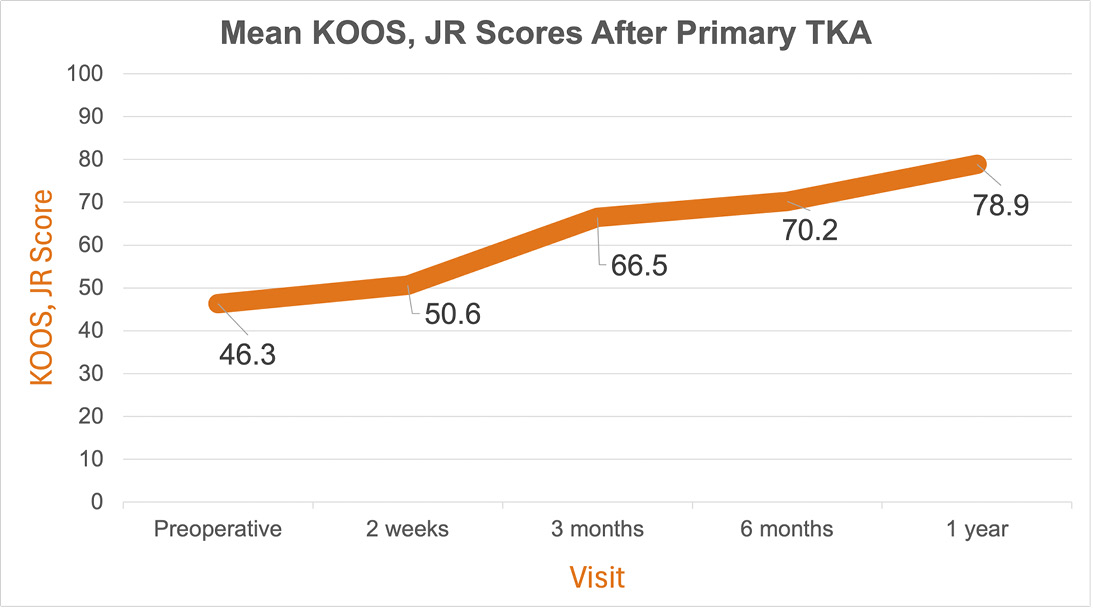
Figure 1: KOOS, JR scores improved steadily following primary total knee arthroplasty, with the greatest gains occurring early after surgery and continued improvement through one year.
Source: Adapted from data presented in Substantial Clinical Benefit Following Primary Total Knee Arthroplasty: Time to Achievement and Factors Associated with Failure, AAOS 2026 Annual Meeting, New Orleans.
Published 10/20/2026
|
Theresa Witham
At a Glance
- 77% of patients achieved substantial clinical benefit one year after primary TKA.
- Higher preoperative KOOS, JR scores and preoperative back pain were independently associated with failure to achieve substantial clinical benefit.
- On average, patients reached the substantial clinical benefit threshold by three months after surgery.
Estimated read time: 4 minutes
More than three-quarters of patients achieved substantial clinical benefit (SCB) one year after primary total knee arthroplasty (TKA), but patients with higher preoperative Knee injury and Osteoarthritis Outcome Score for Joint Replacement (KOOS, JR) scores and those reporting back pain before surgery were significantly less likely to reach that benchmark, according to research presented at the AAOS 2026 Annual Meeting.
The researchers reviewed 1,478 primary TKAs from Aug. 1, 2015, to July 21, 2023, at a single tertiary care academic institution and analyzed matched preoperative and one-year postoperative KOOS, JR scores. Supplemental patient-specific data, including comorbidities, were collected via retrospective chart review.
The study excluded patients younger than age 18 and those without a preoperative KOOS, JR instrument and matched one-year postoperative KOOS, JR instrument.
Previous studies used minimal clinically important difference (MCID) as a threshold to define success for TKA. “However, existing data suggest that SCB may be achieved at much lower rates relative to MCID following primary TKA,” the authors wrote.
“The purpose of this study was twofold: (1) to determine how long it takes to achieve SCB within the first year following primary TKA; and (2) to determine what patient- and surgery-level factors, if any, are associated with failure to achieve SCB at one year after primary TKA,” the researchers wrote.
Study demographics
The mean age at surgery was 64 years, 53% were female, and the mean BMI was 29 kg/m2. Medicare was the most common payer (34%).
---
Related Content
- The Mandatory CMS Inpatient THA/TKA Patient-Reported Outcomes Performance Measure (AAOS resource)
- Mandatory CMS Inpatient THA/TKA PRO-PM Frequently Asked Questions (AAOS resource)
- PROMs in Practice: Advocacy (AAOS resource)
---
For the operative approach, 60% were medial parapatellar and 40% were mid-vastus. The median Charlson Comorbidity Index (CCI) was 5, with an interquartile range (IQR) of 3-7. The median Elixhauser Comorbidity Index was 2, with an IQR of 1-8.
KOOS, JR score collection
Patients were assigned a KOOS, JR score in the electronic medical record (EMR).
Patients who did not complete the KOOS, JR instruments at the time of their clinic visits (preoperative, two weeks postoperative, six to 12 weeks postoperative, four to six months postoperative, one year postoperative) were contacted via an automated email system and asked to complete the instrument. Researchers followed up with non-responsive patients via EMR message and phone calls.
Clinical benefit evident by three months
More than three-quarters (77%) achieved SCB at one year postoperatively. On average, patients reached the SCB threshold by three months after surgery, with continued improvement through one year.
The mean KOOS, JR scores were (Figure 1):
- preoperative: 46.3 (95% confidence interval [CI], 44.3-48.3);
- two weeks postoperative: 50.6 (95% CI, 48.7-52.3);
- three months postoperative: 66.5 (95% CI, 64.3-68.7);
- six months postoperative: 70.2 (95% CI, 68.6-71.8); and
- one year postoperative: 78.9 (95% CI, 76.7-81.2).
In univariate analyses, the following were associated with failure to achieve SCB at one year postoperatively:
- Black race (odds ratio [OR] 1.81, 95% CI 1.12-2.92; P = 0.007);
- higher preoperative KOOS, JR score (OR 1.08, 95% CI 1.07-1.09; P < 0.001); preoperative KOOS, JR score ≥ 60 points (OR 5.11, 95% CI 3.62-7.20; P < 0.001); lower preoperative PROMIS-10 Global Physical Function score (OR 1.13, 95% CI 1.06-1.19; P < 0.001); and
- any preoperative back pain (OR 1.48, 95% CI 1.08 – 2.02; P = 0.02).
In multivariate analyses, these two factors were associated with failure to achieve SCB at one year after primary TKA:
- higher preoperative KOOS, JR scores (OR 1.09, 95% CI 1.07-1.10; P < 0.001); and
- any preoperative back pain (OR 1.9, 95% CI 1.4-2.7; P < 0.001).
Limitations
The authors noted several limitations, including the retrospective study design and incomplete capture of matched preoperative and one-year postoperative KOOS, JR scores, which may introduce selection bias. However, the paired preoperative and one-year postoperative KOOS, JR capture rate of 55% is comparable to other published data on the topic.
In addition, the study did not exclude patients who had a primary TKA and then underwent a revision procedure within the first year after index TKA, but this scenario accounted for just 1.4% of incidences.
The CMS PRO-PM era
The authors explained that the Centers for Medicare & Medicaid Services (CMS) Patient-Reported Outcome-Based Performance Measure (PRO-PM) program has increased the importance of understanding which patient and surgical factors are associated with achieving substantial clinical benefit after primary TKA.
In addition, under CMS PRO-PM, institution-level rates of SCB achievement are planned to be publicly available in the form of a “risk-standardized improvement rate” (RSIR), which is akin to the one-year achievement rate of SCB.
The study did not evaluate perioperative pain management, rehabilitation protocols, or other aspects of postoperative care, so the specific factors underlying the cohort’s relatively high rate of SCB achievement remain uncertain.
As CMS moves toward broader public reporting of patient-reported outcomes after TKA, understanding factors associated with SCB may help surgeons better counsel patients, set realistic expectations, and identify individuals who may benefit from additional preoperative support.
The authors of “Substantial Clinical Benefit Following Primary Total Knee Arthroplasty: Time to Achievement and Factors Associated with Failure” are Christopher N. Carender MD; Zhaorui Wang, MD; Carol Janney, PhD; Brian R. Hallstrom, MD, BSME, FAAOS; Elizabeth A. Dailey, MD, FAAOS; and Michael M. Kheir, MD.
Theresa Witham is managing editor of AAOS Now.