

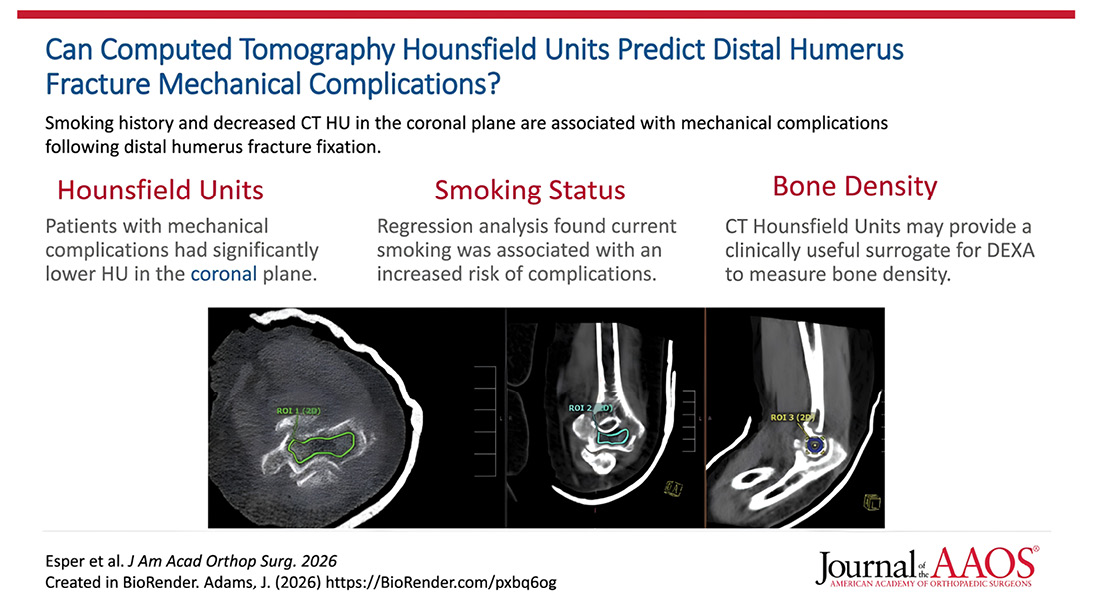
Figure 1: This visual abstract accompanied the article "Can Computed Tomography Hounsfield Units Predict Distal Humerus Fracture Mechanical Complications?" published in the Aug. 15, 2026, issue of JAAOS. It illustrates the format expected for submissions.
Courtesy of the Journal of the AAOS®
Published 10/20/2026
At a Glance
- JAAOS now requires visual abstracts for all new manuscript submissions.
- Submission timing differs for review and research articles.
- Visual abstracts are intended to improve digital engagement and accessibility.
Estimated read time: 2 minutes
The Journal of the AAOS® (JAAOS®) has updated its Instructions for Authors to require visual abstracts for all new article submissions. This change provides authors with another way to communicate key information and findings while helping JAAOS increase reader engagement and keep the journal’s content current and competitive.
A visual abstract is a graphical summary of key information and findings presented in an article (Figure 1). By incorporating these visual summaries into the journal’s content, JAAOS aims to offer readers a concise and visually engaging way to understand the main points of published research and review articles.
For authors, the timing for submitting a visual abstract depends on the article type:
- Review articles: Authors should submit their visual abstract when submitting the full article following acceptance of a JAAOS Review Proposal.
- Research articles: Authors should submit their visual abstract alongside their first revision.
JAAOS has provided an example visual abstract and detailed instructions to help authors understand the expected format, content, and submission requirements. Authors should review these resources before preparing their visual abstract.
“Including visual abstracts is a positive enhancement for readers and authors, as JAAOS has moved to a digital format,” says Peter S. Rose, MD, FAAOS, editor in chief of JAAOS. “It allows an engaging method for readers to evaluate articles on a variety of devices, and it allows greater prominence of authors’ work.”
Overall, the new requirement reflects JAAOS’ effort to modernize its digital presence, increase reader engagement, and ensure the journal remains relevant and competitive by presenting important evidence-based orthopaedic research in a more visually accessible format.
For more information, an example visual abstract, and visual abstract instructions, visit the JAAOS Instructions for Authors.