

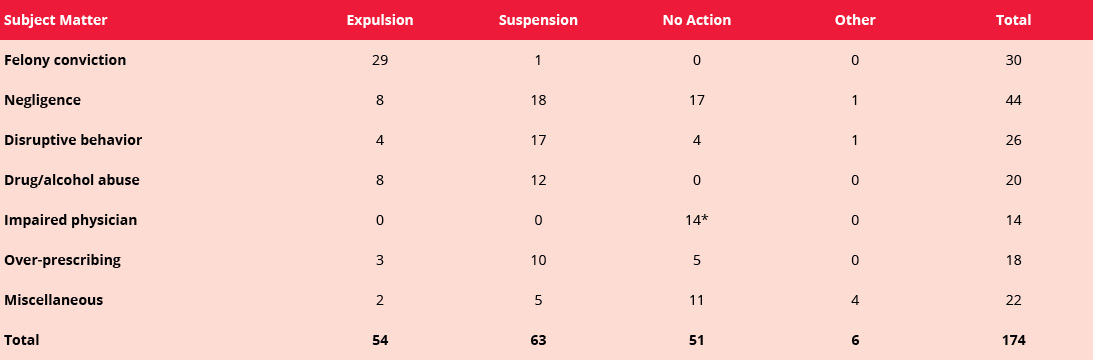
Table 1: Non-SOP matters by subject matter, March 2006 to September 2026 Distribution of non-SOP matters reviewed by the Board from March 2006 through September 2026.
*Resolved as No Action under the Guiding Principles.
*Resolved as No Action under the Guiding Principles.
Source: AAOS Professional Compliance Program.
Published 10/20/2026
|
Judith F. Baumhauer, MD, MPH, FAAOS, FAOA
At a Glance
- Non-SOP reviews address licensure restrictions, felony convictions, narcotics-prescribing limitations, and Fellowship eligibility.
- The Judiciary Committee reviews these matters and makes recommendations to the AAOS Board of Directors.
- Since 2006, the Board has acted on 174 non-SOP matters.
Estimated read time: 6 minutes
Most AAOS Fellows and members know the Professional Compliance Program (PCP) through its Standards of Professionalism (SOPs). The six SOPs set minimum standards for AAOS members’ conduct for expert testimony, industry relationships, and other business activities and professional relationships. Far less visible is a second track of the program, which has nothing to do with expert witness testimony or conflicts of interest and everything to do with a member’s basic standing to practice medicine. This is the non-SOP process, and it is the Judiciary Committee’s responsibility to administer the program from start to finish.
The AAOS Board of Directors codified how this review process works in its Policy for Non-Standards of Professionalism Review, adopted June 12, 2025. This policy consolidates the procedure and the principles that guide it into a single governing document. (See “Policy for Non-SOP Review.”)
Under the PCP Professional Compliance Program in the AAOS Bylaws, a Fellow or member may face a non-SOP compliance action for four reasons:
- any limitation or restriction on the right to practice medicine in any state or Canadian province, including license revocation, suspension, restriction, or voluntary surrender while under investigation;
- any limitation on a license to dispense narcotics;
- conviction of, or a guilty or no-contest plea to, a felony; or
- failing to meet the requirements of Fellowship or membership.
- As none of these reasons involve an alleged SOP violation, these matters are handled outside the grievance process and are known internally as “non-SOPs.”
Discovery
AAOS does not wait for a complaint to learn that a member’s license has been restricted or that a felony conviction has occurred. The policy directs AAOS to gather publicly available information about any Fellow or member facing a licensing board action, a felony conviction or plea, or a restriction on prescribing narcotics. Members carry an independent, parallel obligation: Fellows or members who no longer hold a full, unrestricted license or who have pleaded guilty or no contest to a felony must notify the AAOS Office of General Counsel within 30 days of that action. A lapsed license alone does not trigger review.
Due process
There is no grievance process and no hearing panel in these cases. As a result, due process runs on a different clock than an SOP grievance. Once a matter is identified, AAOS notifies the member, who has 30 days from that notice to submit a written statement and any supporting materials to the Office of General Counsel for the Judiciary Committee’s review. The member is also provided advance notice of when the Board will consider the matter.
There is no live hearing in the non-SOP track. Review is conducted on the written evidence. The written submission is the member’s formal opportunity to be heard, and the committee treats it as central to its review.
How the Judiciary Committee decides
The Judiciary Committee reviews all submitted information and documents, including the underlying licensing action or conviction, any self-reporting, and the member’s written response. It then prepares a recommendation for the AAOS Board, which follows the guiding principles the Policy for Non-Standards of Professionalism Review incorporates. Public and patient safety come first, followed by the potential effect on the reputation of medicine and AAOS. Within that framework, the committee weighs mitigating and aggravating factors. These include self-reporting, whether a licensing action stemmed from reckless disregard for the truth or an intent to deceive, and, in substance-use cases, compliance with a monitored treatment program and acceptance of responsibility.
AAOS does not generally second-guess a state licensing board’s or court’s underlying findings. When a member holds licenses in multiple states, the committee looks only at the license in the state or states where the member actually practices. A felony conviction or no-contest plea, and a finding of scientific or research fraud, generally result in expulsion.
Four levels of action
The Bylaws give the Board four possible sanctions, imposed by a two-thirds vote of committee members present and voting: reprimand, censure, suspension, and expulsion. A reprimand is a written sanction placed in the member’s file. It carries no loss of Fellowship benefits and, unlike the other three sanctions, is not published. It is disclosed only under subpoena. A censure likewise leaves Fellowship intact but is an official, nonconfidential action that will be published. A suspension removes the benefits of Fellowship or membership for a defined term, after which the individual may seek reinstatement upon payment of any outstanding dues or fees. An expulsion removes the individual from AAOS’ rolls entirely, although a reapplication may later be considered if all requirements for Fellowship are again met.
Censure, suspension, and expulsion actions are each published in one or more AAOS publications. Pursuant to the Association Bylaws, notice of a censure, suspension, or expulsion is also sent to the American Board of Orthopaedic Surgery and the relevant state orthopaedic society, state medical association, and state medical board.
The Board’s decision takes effect immediately, and the member is notified within 30 days. The Board’s decision is final.
Since March 2006, the Board has acted on 174 non-SOP matters (Table 1): 54 expulsions, 63 suspensions, 51 instances of no action (including 14 resolved under the Guiding Principles), and six other outcomes such as a Letter of Concern, censure, or resignation in lieu of action. Felony convictions account for 30 of these matters, with 29 resulting in expulsion. Negligence, disruptive behavior, drug or alcohol abuse, over-prescribing, and impaired-physician matters make up most of the remainder.
Why it matters
The non-SOP process rarely draws the attention that expert-witness grievances do, but it addresses the most fundamental membership question AAOS faces: whether a Fellow or member currently meets the basic requirements of licensure and ethical standing that the Fellowship name would suggest to the medical community. The Judiciary Committee’s work here is quieter than a contested hearing, but the stakes are just as high, both for the affected member and for the credibility of the Fellowship as a whole. By grounding its recommendations in publicly available facts, a defined notice-and-response process, and a consistent set of Guiding Principles, the committee aims to give every member facing a non-SOP review the fairness and consistency needed to reinforce public confidence in the AAOS Fellow designation.
Contributing active and former Judiciary Committee Members
Herb Alexander, MD, FAAOS; John P. Lubicky, MD, FAAOS; James T. Ninomiya, MD, MS, FAAOS; Patrick St. Pierre, MD, FAAOS; Thomas B. Fleeter, MD, MBA, FAAOS; Tammy L. Martin, MD, FAAOS; James M. Saucedo, MD, MBA, FAAOS; Jason Strelzow, MD, FAAOS; Matthew T. Wallace, MD, FAAOS
Judith F. Baumhauer, MD, MPH, FAAOS, FAOA, is chair of the Judiciary Committee.