

Published 8/25/2026
|
Alexandra E. Page, MD, FAAOS
At a Glance
- Ambient AI scribes are among the fastest-adopted healthcare technologies in recent years.
- Early studies suggest benefits for documentation burden and physician burnout.
- Physicians remain responsible for reviewing, editing, and validating AI-generated notes.
Estimated read time: 5 minutes
In the decades since electronic health records (EHRs) permeated medical practice, conversations with patients have devolved into keyboard tapping and hours spent completing charts at home. Ambient artificial intelligence (AI) scribes offer the potential to enrich the patient-doctor interaction. These systems use artificial intelligence to capture and transcribe clinical conversations, automatically creating medical documentation with minimal clinician input.
An interview conducted with orthopaedic surgeon Peter Schilling, MD, and machine learning scientist Brandon Hill, MSc, offered perspectives on how ambient AI scribe technology is currently impacting practice as well as cautions on potential risks. A companion article addresses broader considerations of how AI content generated from an office visit can be used or misused, including what is lost when the physician is removed from generating an office note.
Dr. Schilling and Hill bring deep expertise as cofounders of the Center for AI Research in Orthopaedics (CAIRO) at Dartmouth-Hitchcock Medical School. Dr. Schilling is an assistant professor who specializes in joint replacement; both he and Hill had previously worked in Silicon Valley in the fields of machine learning and AI algorithms and products.
Already in a clinic near you
Their rapid adoption by health systems and physicians speaks to the transformative impact of ambient AI scribes. A 2025 study by Poon and colleagues found that 100% of responding health systems reported using ambient documentation. Hill identified this as one of the most rapidly adopted healthcare technologies since the 2009 Health Information Technology for Economic and Clinical Health Act accelerated the adoption of EHRs and enhanced the privacy and security requirements for protected health information, noting about one-third of clinicians now have access to ambient scribes.
---
Related Content
- Clinic notes in an AI era: The medium can change the message and the messenger (AAOS Now)
- How AI Is Transforming Orthopaedics (AAOS Now Podcast)
- Large Language Models Outperform PGY-5 Residents on the Orthopaedic In-Training Examination (Journal of the AAOS®)
---
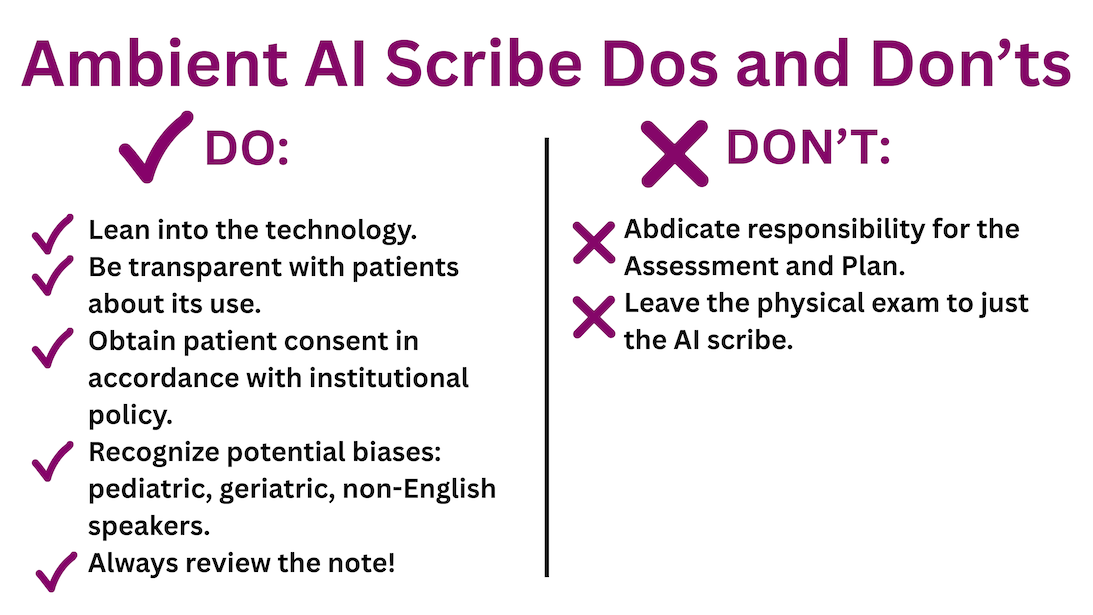
Dr. Schilling noted that the “ambient” scribe goes far beyond simple voice recognition of the past, saying “These tools …actually listen to the conversation … identify what is relevant … then actually generate structured documentation.” He acknowledged that while the technology is excellent at recording narrative conversation, its accuracy on the physical exam is more limited.
Optimizing the ambient AI scribe encounter
Dr. Schilling walked through a patient visit using the ambient scribe. He explained that each use of a scribe needs to be identified in the EHR to enable entering the correct template.
- Use AI technology to prepare a summary for every patient on the schedule, based on the EHR.
- With the app running, explain the technology and obtain the patient’s permission to use it.
- A templated EHR exam may produce a more accurate, efficient, and consistent documentation than narration while performing the exam.
- Use the mobile app to generate the structured note, typically done within seconds.
- Review the generated note (ideally while memory of the encounter is still fresh), make additions and edits as necessary, and sign.
Of the final step, Dr. Schilling made a critical observation: “We’re not as much an author as we are an editor — and let’s hope we keep being editors because it is incredibly easy to get lazy. Don’t use AI as an excuse to stop thinking critically. Clinical judgment, synthesis, and decision making remain the physician’s responsibility.”
Improve patient interaction . . . or not?
A chief advantage of the technology is a returned focus on the patient. From Dr. Schilling’s perspective, it frees him to engage with the patient, focus on the overarching story, connect data points, and begin clinical reasoning rather than transcribing. But he also cautioned that the ambient scribe could be an interloper. As he explains further in the companion article “Clinic notes in an AI era,” transparency about AI use and building trust with the patient is vital. Hill observed that patients, knowing everything is being recorded, may feel less comfortable bringing up sensitive subjects.
An antidote to burnout
Enabling the physician to be more present in the exam room is valuable, but an even more persuasive argument is the potential for AI scribes to decrease the hours of low-value clerical work that contribute to burnout. Early studies demonstrate reductions in documentation time and reported physician burnout. One multicenter study from Olson et al. across six health centers showed burnout decreased from 51.9% to 38.8% after just 30 days of implementation. Another study by You et al. of 1,430 clinicians also found decreased burnout and increased perceived well-being after incorporating AI scribes.
“Having worked on ambient documentation technology and now using it every day as a practicing orthopaedic surgeon, I’ve come to see that the greatest benefit isn’t fewer clicks,” explained Dr. Schilling. “It’s that documentation fades into the background, allowing the physician-patient relationship to move back into the foreground. That’s good for patients, and it’s good for physicians.”
Risks and downsides
Risks and limitations exist with the technology. Hill noted ambient scribes demonstrate biases based on the speaker. Scribe technology may be less effective when used with non-English speakers and both geriatric and pediatric patients. Further, data suggest lower use of the technology when a translator is used. Beyond language, nonverbal cues such as facial expressions or pain responses cannot be captured.
As with other AI applications, hallucinations can occur. Of particular importance to orthopaedic surgeons, Hill noted the physical exam tends to generate the highest rate of hallucinations, presumably because the exam is performed silently and the scribe seeks to fill the void. Omissions are perhaps the most dangerous risk: With nothing in the output, even careful physician review of the note may fail to catch the error. The scribe also may misattribute speakers or create contextual misinterpretations of comments.
Returning focus to the patient, not the screen, can elevate the experience of everyone in the exam room. Currently, the technology is transformative for specialties focused on the patient narrative. For orthopaedic surgeons, additional work may be needed until the ambient AI scribe can precisely record the physical exam. As with any new technology, optimization requires practice.
“This is the future,” advised Dr. Schilling. “You’ve got to get accustomed to it, understand where it excels, what its failure modes are, how it works for your workflow.”
Alexandra E. Page, MD, FAAOS, is a foot and ankle specialist in private practice in San Diego, California, and the editor-in-chief of AAOS Now.
References
- Olson KD, Meeker D, Troup M, et al. Use of ambient AI Scribes to reduce administrative burden and professional burnout. JAMA Netw Open. 2025;8(10):e2534976. doi:10.1001/jamanetworkopen.2025.34976
- Poon EG, Lemak CH, Rojas JC, Guptill J, Classen D. Adoption of artificial intelligence in healthcare: survey of health system priorities, successes, and challenges. J Am Med Inform Assoc. 2025 Jul 1;32(7):1093-1100. doi: 10.1093/jamia/ocaf065. PMID: 40323320; PMCID: PMC12202002.
- You JG, Dbouk RH, Landman A, et al. Ambient documentation technology in clinician experience of documentation burden and burnout. JAMA Netw Open. 2025;8(8):e2528056. doi:10.1001/jamanetworkopen.2025.28056