

Published 8/26/2026
|
Alexandra E. Page, MD, FAAOS
At a Glance
- Ambient AI changes not only documentation, but also how information is created and interpreted.
- Delegating note creation may affect physician reflection and clinical synthesis.
- Transparency, privacy, and continued physician oversight remain essential.
Estimated read time: 4 minutes
For physicians, the clinic note has specific purposes: documenting the patient history and exam and offering a clinical assessment and planned next steps, all preserved for future reference. However, the electronic health record (EHR) has always been used by other health system stakeholders in the health system. As artificial intelligence (AI) moves into the clinic, the “message” in the EHR can be influenced by these other users as well as physicians.
AAOS Now interviewed orthopaedic surgeon Peter Schilling, MD, and machine learning scientist Brandon Hill, MSc, to explore the broader considerations and implications of AI and ambient scribes. A companion article, “Eyes on the patient, not the screen: The orthopaedic case for ambient AI,” based on the interview conversation, focuses on the current state of AI in the orthopaedic clinic.
Hill and Dr. Schilling bring deep expertise as cofounders of the Center for AI Research in Orthopaedics (CAIRO) at Dartmouth-Hitchcock Medical School. Dr. Schilling is an assistant professor of orthopaedic surgery, specializing in joint replacement; both he and Hill had previously worked in Silicon Valley in the fields of machine learning and AI algorithms and products.
"The medium is the message"
Dr. Schilling invoked Marshall McLuhan, a philosopher and media theorist who famously stated, “The medium is the message.” For Dr. Schilling, AI represents “a foundational way our information is delivered, . . . created, and organized.” Using this new medium in the exam room allows the physician to focus on the patient, but it also brings risks, including possible erosion of trust.
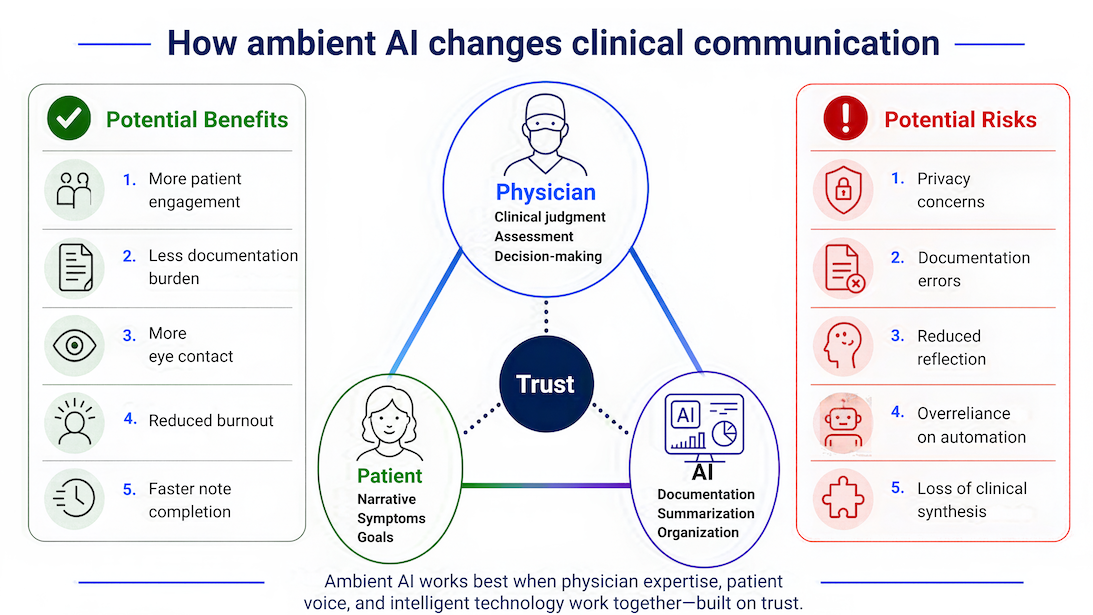
Dr. Schilling portrays AI as a third member in the traditional patient-doctor relationship, thus creating a triangle, with AI providing a parallel source of information. This changes where patients place trust: rather than having the physician seen as the source of authority, the AI interloper introduces another “expert” into the room, potentially undermining physician credibility. Recognizing this change must be considered when implementing the ambient AI scribe (as well as any AI tool).
“Lean into the technology in terms of being forthright and transparent with your patients about it,” Dr. Schilling suggested. “That’s what will continue to instill trust … complete transparency about what you’re doing, how you’re using it.”
Automation impacts the messenger
As important as the medium may be for the message, AI also impacts the messenger. With responsibility for translating a patient encounter into a diagnosis with a plan, the physician has always been the messenger for the patient’s medical issue. Abdicating that role to AI risks compromising physician clinical acumen.
For many physicians, even if the history and physical exam can be recorded in the room, the process of forming an assessment and developing a plan requires reflection. Historically, this could occur when compiling scribbles from the encounter into a written chart note. Even with an EHR, typing a note that created a logical flow was in the hands of the creator.
---
Related Content
- Eyes on the patient, not the screen: The orthopaedic case for ambient AI (AAOS Now)
- How AI Is Transforming Orthopaedics (AAOS Now Podcast)
- Large Language Models Outperform PGY-5 Residents on the Orthopaedic In-Training Examination (Journal of the AAOS®)
---
In a recent New York Times essay, an ER physician noted her cognitive shift — using the AI scribe as an interloper changed how she listened to the patient. She also recognized that the process of assessment and decision making vanishes when note completion is outsourced.
Hill commented on this point specifically, noting, “We still have to learn the long-term effect of not having clinicians take that moment to go back and reflect about that patient as much, because they had to synthesize it all. Instead, it’s synthesized, and now they’re merely reviewing.” He believes evolving design features that allow AI to acknowledge lack of confidence may help users keep their brains engaged. Dr. Schilling agreed: “That is the thing I am most concerned about: our ability to learn, our ability to synthesize.” He rarely allows residents to use the ambient scribe.
“Don’t use AI as an excuse to stop thinking critically,” said Dr. Schilling. “Clinical judgment, synthesis, and decision making remain the physician’s responsibility. Ambient AI should reduce the burden of documentation, not the burden of thinking. For trainees especially, the cognitive work of medicine is the curriculum.”
Where does the audio go
Exploring the darker side of this automation, Hill recognized the unknowns around the storage of the collected data. The audio is obtained with consent and is protected by HIPAA, but everything from location to duration of storage is less clear, and the speed of adoption may be compromising protections. “Personal information [is] fractured and now stored in many different places . . .” he said. “This is all moving so quickly that there are no legal requirements in terms of how long these should stay or not stay. And so, a lot of this is still being worked out, actively.”
What constitutes a “good” note
Most surgeons will identify overarching components of a good clinic note, but details are a matter of training, experience, and opinion. The clinician writing the note controls these aspects to produce a “good” note. However, Hill observes, in reality “[the chart notes] serve many masters: billing, legal defense, communications between clinicians, the patient’s own record, and [even] . . . records for future research.” Other users of the record may have alternate perspectives on what constitutes a good note. Ambient data collected by the scribe that may not have even made it into the clinical note may still appear in a chart summary requested by, say, the billing department. The ambient scribe, by assuming the role formally held by the clinician, may become empowered to reflect other perspectives. According to Hill, episodes of unintentional upcoding have already been identified.
Losing control of AI is a threat that has been voiced in nearly every use of the technology. Hill and Dr. Schilling recognize in these early stages of development, many questions remain unanswered and design choices are evolving that, ideally, will lead to a technology that accurately collects information while prioritizing patient privacy. As a machine learning scientist, Hill believes the onus is on AI designers to put safeguards on the technology to protect the end product and keep the user’s brain engaged.
Harnessing the power of the tool while remaining aware of its limitations allows surgeons to reap benefits without sacrificing cognitive mastery, a policy that protects trust in the patient-doctor relationship. And certainly, remember the final step: Always check those ambient AI scribe notes!
Alexandra E. Page, MD, FAAOS, is a foot and ankle specialist in private practice in San Diego, California, and the editor-in-chief of AAOS Now.
References
- Olson KD, Meeker D, Troup M, et al. Use of ambient AI scribes to reduce administrative burden and professional burnout. JAMA Netw Open. 2025;8(10):e2534976. doi:10.1001/jamanetworkopen.2025.34976
- Yuan J. How A.I. might change the way doctors think. New York Times. Published July 1, 2026. Accessed July 28, 2026. https://www.nytimes.com/2026/07/01/magazine/ai-medical-scribes-doctors.html