

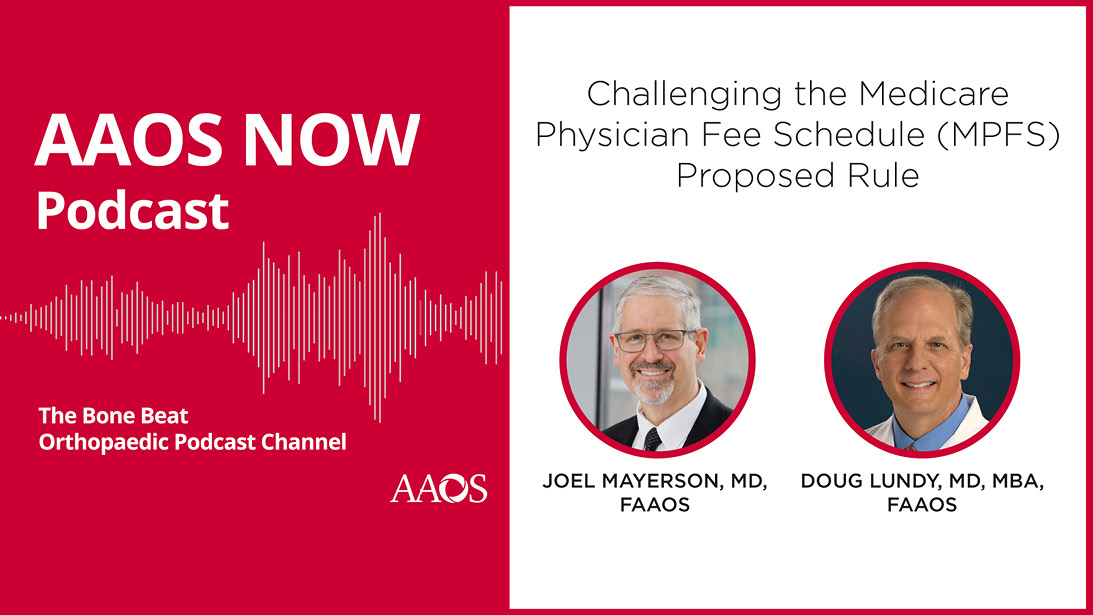
Joel Mayerson, MD, FAAOS, chair of the AAOS Advocacy Council, joined AAOS Now Podcast host Douglas Lundy, MD, MBA, FAAOS to discuss the Calendar Year 2027 Medicare Physician Fee Schedule proposed rule and AAOS' response.
Published 10/20/2026
|
Theresa Witham
At a Glance
- The CY 2027 Medicare Physician Fee Schedule proposed rule threatens physician practice viability and patient access to musculoskeletal care.
- AAOS opposes proposed reductions in arthroplasty procedure valuations, payment changes affecting modifier 25 claims, and revisions to practice expense RVU calculations.
- AAOS urges CMS to pause the proposals and asks members to engage in grassroots advocacy.
Estimated reading time: 5 minutes
The Calendar Year 2027 Medicare Physician Fee Schedule (MPFS) proposed rule could threaten physician practice viability and patient access to musculoskeletal care, according to AAOS leaders. During a recent AAOS Now Podcast episode, Joel Mayerson, MD, FAAOS, chair of the AAOS Advocacy Council, joined host and AAOS Now Deputy Editor Douglas Lundy, MD, MBA, FAAOS, to discuss the proposal’s potential impact and AAOS’ response.
Three provisions are of particular concern to orthopaedic surgery: proposed reductions in relative value units (RVUs) for total hip, total knee, total shoulder, and shoulder hemiarthroplasty procedures; reduced payment for evaluation and management (E/M) services billed with modifier 25 on the same day as a procedure; and changes to the calculation of practice expense RVUs. In a letter to the Centers for Medicare & Medicaid Services (CMS), AAOS has called for a pause and reconsideration of the proposals rather than allowing them to move forward in their current form.
Proposed arthroplasty cuts draw sharp opposition
According to Dr. Mayerson, the proposed reductions for arthroplasty procedures are unprecedented in scope, “and they’ve targeted some of the most successful and life-changing procedures in all of medicine,” he said. “These procedures aren’t elective in a way many people outside medicine sometimes use that word.”
Dr. Mayerson noted that the proposed rule includes a 20% reduction in valuation for affected arthroplasty services and warned that the impact would extend beyond surgeons. Independent practices, rural practices, and practices with a high Medicare patient population may face increasing financial pressure, potentially affecting where and how care is delivered. He emphasized that AAOS’ concern centers on maintaining patient access to care, particularly for older adults and patients living in rural areas.
Same-day care payment policy raises access concerns
The podcast also addressed CMS’s proposal to reduce payment when an E/M service and a procedure are performed during the same visit. Dr. Mayerson explained that orthopaedic surgeons frequently evaluate a patient, review imaging, discuss treatment options, and provide a medically necessary procedure during a single encounter. “We use a 25-modifier code, and that allows us to receive a 100% payment for both the E/M code and the procedure code,” he explained. “The new proposal is that the most expensive code be paid at 100% and all subsequent codes be paid at 50%.”
If Medicare reduces payment for these services “simply because the appropriate evaluation and treatment occur on the same day, the practical effect may be that patients are asked to return for another visit,” Dr. Mayerson said. “That means more travel, more time away from their family or work, more cost sharing, and delays in treatment. It’s especially problematic for our elderly patient population, patients with mobility issues, and patients who live in rural areas who also travel from long distances.”
Related Content
- President’s Message: Protecting independent practice and patient access (AAOS Now)
- CMS Payment Resource Center (AAOS resource)
- Take action through the AAOS Advocacy Action Center (AAOS resource)
To address the issue, AAOS has joined the Same Day Care Coalition, which is advocating for policies that preserve timely, coordinated care and avoid unnecessary obstacles for patients. The Same Day Care Coalition is a nationwide coalition of primary care physicians, medical specialists, surgical specialists, and patient groups formed to advocate for Medicare payment policies that preserve access to medically necessary same-day care. Other members include the American College of Surgeons, American Society of Anesthesiologists, the American Academy of Dermatology Association, the American Academy of Neurology, and many others.
Rural and independent practices may face added strain
Although arthroplasty surgeons would be most directly affected, Dr. Mayerson stressed that the proposed policies would have consequences across orthopaedic surgery.
“Every orthopaedic practice is going to feel some effect [from] this,” he said. “We all have arthroplasty partners. They’re going to feel the most effect, but it [will impact] almost every orthopaedic practice in America.”
Independent and rural practices could face particular challenges because they often operate with fewer resources and thinner margins. Dr. Mayerson warned that additional financial pressure could accelerate consolidation, reducing local access points for musculoskeletal care.
Patients could also experience significant downstream effects, including longer wait times. “Delayed musculoskeletal care can mean worsening pain, loss of independence for our seniors, increased fall risks, more emergency room visits, and long-term greater cost to our healthcare system,” Dr. Mayerson warned.
AAOS expands advocacy response
Dr. Mayerson said AAOS’ response to the proposed rule differs from previous advocacy efforts because of the magnitude of the threat.
“We’ve submitted formal comments to CMS, as we do each year,” he said. “But this year, given the magnitude of the threat, we’ve gone beyond the traditional comment process.”
AAOS has urged CMS to pause the proposed changes and maintain 2026 payment values while stakeholders work toward a more stable, evidence-based payment policy. AAOS is also engaging Congress, communicating directly with CMS leadership, and working through coalition partnerships to oppose provisions that could reduce patient access to care.
“This is a full stop,” Dr. Mayerson said. “We believe you [CMS] are wrong, and this is why, and you need to put a pause until we can collectively come up with a better idea.”
Members urged to engage policymakers
Throughout the discussion, both surgeons emphasized the importance of grassroots advocacy.
“The most important message is every member can do something and needs to do something,” Dr. Mayerson said. “This is a time where we need to act.”
Members can support AAOS advocacy efforts by visiting the CMS Payment Resource Center and contacting their legislators through the AAOS Advocacy Action Center. Dr. Mayerson encouraged surgeons to share patient stories and communicate directly with policymakers about the real-world effects of the proposed rule.
“I truly believe advocacy is an extension of patient care,” Dr. Mayerson said. “When we advocate, we’re not just speaking for ourselves; we’re speaking for the patients who need access to our care, the communities we serve, and really the future of our profession.”
Theresa Witham is managing editor of AAOS Now.