

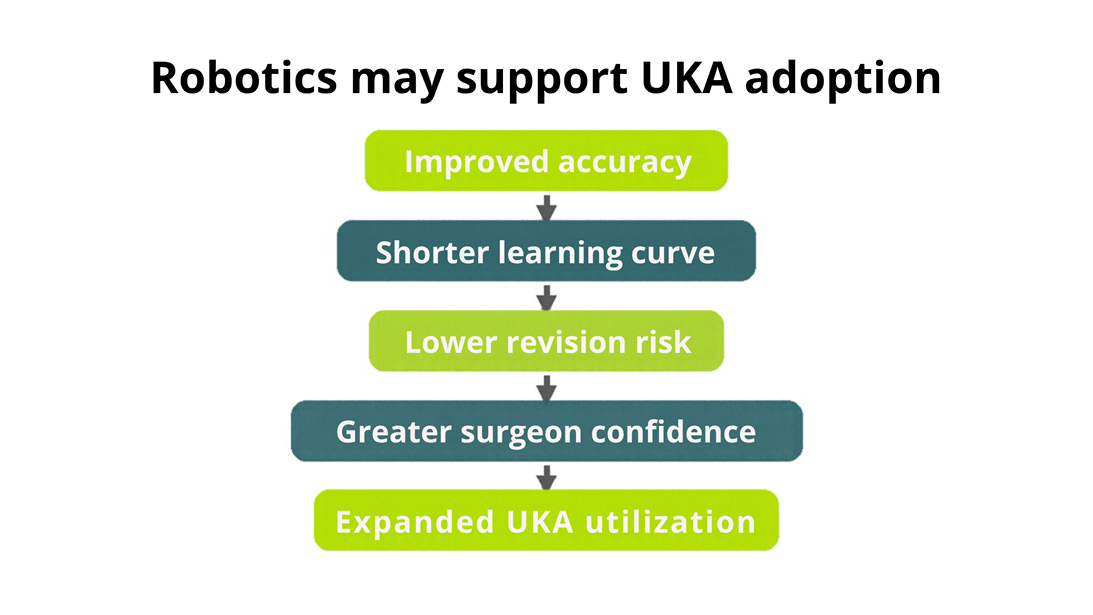
Robotics may facilitate broader adoption of UKA through improved accuracy, a shorter learning curve, lower revision risk, and greater surgeon confidence.
Published 10/20/2026
|
Hadi Aziz MD; Siddhant Saxena BS; Morteza Meftah MD; Matthew Hepinstall MD, FAAOS
At a Glance
- Robotics may improve implant positioning and limb alignment in UKA.
- Robotic systems may help reduce technical barriers and shorten the UKA learning curve.
- Improved accuracy and survivorship could expand access to UKA for appropriate patients.
Estimated read time: 6 minutes
When compared with total knee arthroplasty (TKA), unicompartmental knee arthroplasty (UKA) is less invasive and offers quicker recovery, more natural kinematics, and excellent functional outcomes. UKA is often considered more cost-effective than TKA, although relative cost-effectiveness depends on how cumulative costs are measured.
While restrictive indications for UKA were proposed by Kozinn and Scott, subsequent studies demonstrated that patients who were excluded by these criteria (on the basis of age, weight, or activity level) would receive greater or at least equal benefit from the procedure. Isolated medial compartment arthritis represents a significant proportion of knee osteoarthritis cases: a recent meta-analysis identified isolated medial compartment disease in 27% of osteoarthritic knees, suggesting UKA could potentially be offered to a considerable share of knee arthroplasty patients.
Even so, many surgeons follow restrictive indications, while others preferentially offer TKA to all knee arthroplasty patients. The 2025 American Joint Replacement Registry report shows that use of UKA is declining as a share of knee arthroplasties, accounting for less than 5% since 2015. Furthermore, the majority of UKAs (93%) are performed by surgeons who complete 15 or fewer procedures annually. This may be problematic, given evidence linking outcomes to surgical volume in UKA.
Many authors believe UKA remains substantially underutilized. The increased availability of robotic surgical tools, however, may directly or indirectly address several primary barriers to more frequent UKA use.
Issue #1: Technical demands of UKA
UKA is technically demanding and leaves less margin for error than TKA: manual instrumentation achieves target component position in fewer than a third of knees, and malalignment has been linked to accelerated wear and early loosening. Robotic surgery directly addresses these challenges by enhancing the accuracy and precision of bone preparation. Multiple studies across multiple robotic platforms, including several randomized controlled trials, clearly show that robotic-assisted UKA (RA-UKA) improves several concrete measures of surgical success, including more accurate implant placement and more faithful restoration of lower-limb alignment relative to the preoperative plan. Not all data are concordant: one randomized trial found no two-year outcome difference between robotic and manual UKA, though it was small. Larger pooled analyses still favor RA-UKA for revision rates.
Issue #2: Surgeon experience and the learning curve
The steep learning curve of UKA is reflected in higher rates of error and early revision among low-volume UKA surgeons. This likely creates a self-reinforcing cycle: relatively few surgeons perform enough UKAs to reliably achieve the best results, while less optimal UKA outcomes discourage broader adoption.
The accuracy and precision of robotic surgery may address this issue directly, improving the outcomes of lower-volume UKA surgeons sufficiently to encourage more patients to seek the procedure and more surgeons to offer it. Recent studies have shown robotics to alleviate the sharp learning curve associated with manual UKA while significantly improving implant placement and limb alignment in the hands of lower-volume UKA surgeons. RA-UKA carries its own learning curve of roughly 11 cases with initially longer operative times, but this is shorter than that of manual UKA, and efficiency improves with experience.
---
Related Content
- Personalized alignment in UKA: Moving beyond mechanical neutral (AAOS Now)
- Alignment and Balance Methods in Total Knee Arthroplasty (JAAOS®)
- Cases Solved! Medial Unicompartmental Knee Arthroplasty (AAOS resource)
---
Issue #3: Survivorship and revision risk
Concerns around early revision rates and implant survival represent a third barrier to UKA adoption. Because malalignment is a primary driver of UKA failure, enhanced positioning with RA-UKA is expected to improve implant longevity. Studies have demonstrated lower complication and revision rates overall with the use of robotics in UKA, even with surgeons who are less experienced. One prospective cohort showed no reduction in complications at 90 days, though pain and early recovery still favored RA-UKA; even so, longer follow-up analyses show revision risk to be lower with robotics. In these ways, robotics has shown promise in helping surgeons navigate a primary barrier to performing UKA.
Issue #4: Ease of conversion
A frequently cited advantage of UKA is preservation of bone stock and the cruciate ligaments. Conversely, asymmetric bone loss and compromise of ligaments can complicate subsequent conversion to TKA when UKA fails, resulting in conversion procedures that more often resemble revision TKA than primary TKA. If the index UKA is performed with minimal bone cuts in target alignment, the extent of bone loss and ligament damage at the time of any conversion surgeries should be minimized, making the occasional conversion to TKA more closely resemble primary TKA.
Robotics may also help with the conversion procedure. In a matched case-control study, imageless robotic-assisted conversion of UKA to TKA achieved alignment accuracy, implant sizing, bone preservation, and operative times comparable to primary robotic TKA, without the need for augments or increased implant constraint. Thus, the availability of robotic assistance for both UKA and TKA may allow the occasional UKA that ultimately fails to be revised with relative simplicity and reliability, similar to a primary procedure.
Evolving cost considerations
The economics are nuanced: RA-UKA carries higher upfront costs compared with manual UKA, but cost modeling suggests these are ultimately offset by better revision rates, with progressively greater savings at higher-volume facilities. While robotics was initially associated with added cost and longer operative times, accumulating data suggest these tradeoffs diminish as systems mature and case volumes grow. In contemporary platform-based adoption, support for UKA is available on existing robotic arthroplasty systems in use for TKA, rather than requiring the purchase of separate robotic platforms for the sole purpose of performing UKA.
Robotics seems poised to make a positive impact on UKA
Despite clear advantages for eligible patients, UKA remains underutilized. Concerns around the reliability of outcomes, together with barriers to technical accessibility and surgeon confidence, have prevented surgeons from embracing expanded indications for UKA and offering it to the many patients who could be eligible. The role of robotics in UKA is still evolving, and the literature reflects a mixed perspective on the net benefits.
Nevertheless, data have clearly shown RA-UKA to improve technical aspects of the operation, including the accuracy and precision of implant positioning, with the potential to help expand the pool of surgeons who can reliably perform and confidently offer access to UKA. In this way, RA-UKA may offer meaningful potential for expanding both access to and the success of UKA for patients with isolated unicompartmental arthritis.
Hadi Aziz, MD, is a PGY-3 orthopaedic surgery resident at NYU Langone Orthopedics. With research interests in improving outcomes in patients undergoing hip and knee replacements, he aims to pursue a fellowship in adult reconstruction.
Siddhant Saxena, BS, is a second-year medical student at NYU Grossman School of Medicine with research interests in orthopaedic surgery and leadership in student-run community health organizations.
Morteza Meftah, MD, is an associate professor of orthopaedic surgery and a member of the Division of Adult Reconstructive Surgery at NYU Langone Orthopedic Hospital, where his clinical and research focus is total and unicompartmental knee arthroplasty, robotic-assisted surgery, personalized alignment, and patient-reported outcomes.
Matthew Hepinstall MD, FAAOS, is a board-certified orthopaedic hip and knee surgeon with expertise in robot-assisted and less invasive surgical techniques including partial knee replacement and anterior hip replacement. He is an associate professor of orthopaedic surgery at NYU Langone Health in New York.
References
- Tille E, Beyer F, Auerbach K, Tinius M, Lützner J. Better short-term function after unicompartmental compared to total knee arthroplasty. BMC musculoskeletal disorders, 2021;22(1):326. doi.org/10.1186/s12891-021-04185-w.
- Ghomrawi HM, Eggman AA, Pearle AD. Effect of age on cost-effectiveness of unicompartmental knee arthroplasty compared with total knee arthroplasty in the U.S. J Bone Joint Surg Am. 2015;97(5): 396-402. doi.org/10.2106/JBJS.N.00169.
- Shankar S, Tetreault MW, Jegier BJ, Andersson GB, Della Valle CJ. A cost comparison of unicompartmental and total knee arthroplasty. Knee. 2016;23(6): 1016-1019. doi.org/10.1016/j.knee.2015.11.012.
- Mittal A, Meshram P, Kim WH, and Kim TK. Unicompartmental knee arthroplasty, an enigma, and the ten enigmas of medial UKA. J Orthop Traumatol. 2020;21(1): 15. doi.org/10.1186/s10195-020-00551-x.
- Mohebbi S, Khani Y, Amiri A, et al. Economic evaluation of robotic-assisted versus manual unicompartmental knee arthroplasty: a systematic review of Markov models and clinical studies. J Orthop Surg Res. 2025;20(1): 623. doi.org/10.1186/s13018-025-06017-2.
- Hamilton TW, Pandit HG, Jenkins C, Mellon SJ, Dodd CAF, Murray DW. Evidence-Based Indications for mobile-bearing unicompartmental knee arthroplasty in a consecutive cohort of thousand knees. J Arthroplasty. 2017;32(6): 1779-1785. doi.org/10.1016/j.arth.2016.12.036.
- Pandit H, Jenkins C, Gill HS, et al. Unnecessary contraindications for mobile-bearing unicompartmental knee replacement. J Bone Joint Surg Br. 2011;93(5):622-628. doi.org/10.1302/0301-620X.93B5.26214.
- Stoddart JC, Dandridge O, Garner A, Cobb J, van Arkel RJ. The compartmental distribution of knee osteoarthritis: a systematic review and meta-analysis. Osteoarthritis Cartilage. 2021;29(4): 445-455. doi.org/10.1016/j.joca.2020.10.011.
- American Academy of Orthopaedic Surgeons. American Joint Replacement Registry 2025 annual report supplement preview. Published March 2, 2026. Accessed Sept. 4, 2026. https://www.aaos.org/aaos-home/newsroom/press-releases/american-joint-replacement-registry-2025-annual-report-supplement-preview/.
- Jennings JM, Kleeman-Forsthuber LT, Bolognesi MP. Medial unicompartmental arthroplasty of the knee. J Am Acad Orthop Surg. 2019;27(5): 166-176. doi:10.5435/JAAOS-D-17-00690.
- Guild G, Schwab J, Ross BJ, McConnell MJ, Najafi F, Bradbury TL. Is robotic-assisted unicompartmental knee arthroplasty compared to manual unicompartmental knee arthroplasty associated with decreased revision rates? An updated matched cohort analysis. Arthroplast Today. 2025;32:101652. doi:10.1016/j.artd.2025.101652.
- Bell SW, Anthony I, Jones B, MacLean A, Rowe P, Blyth M. Improved accuracy of component positioning with robotic-assisted unicompartmental knee arthroplasty: Data from a prospective, randomized controlled study. J Bone Joint Surg Am. 2016;98(8):627-635. doi:10.2106/JBJS.15.00664.
- Karia M, Masjedi M, Andrews B, Jaffry Z, Cobb J. Robotic assistance enables inexperienced surgeons to perform unicompartmental knee arthroplasties on dry bone models with accuracy superior to conventional methods. Adv Orthop. 2013;2013:481039. doi:10.1155/2013/481039.
- Chen X, Wang B, Huang J, et al. Mid- to long-term complications and revision rates of robotic-assisted unicompartmental knee arthroplasty: a systematic review and meta-analysis. Front Surg. 2025;12:1619644. doi:10.3389/fsurg.2025.1619644.
- Diquattro E, Lettner J, Adriani M, Prill R, Salzmann M, Becker R. High accuracy of component positioning and restoration of lower limb alignment using robotic medial unicompartmental knee arthroplasty. Knee Surg Sports Traumatol Arthrosc. 2025;33(6):1982-1991. doi:10.1002/ksa.12484.
- Roche M. The MAKO robotic-arm knee arthroplasty system. Arch Orthop Trauma Surg. 2021;141(12):2043-2047. doi:10.1007/s00402-021-04208-0.
- Liu P, Lu FF, Liu GJ, et al. Robotic-assisted unicompartmental knee arthroplasty: a review. Arthroplasty. 2021;3(1):15. doi:10.1186/s42836-021-00071-x.
- Cantivalli A, Cottino U, Bonasia DE, Rosso F, Rossi R. Robotic systems in knee surgery: current concepts and future perspectives. Prosthesis. 2023;5(4):1257-1274. doi:10.3390/prosthesis5040086.
- Gilmour A, MacLean AD, Rowe PJ, et al. Robotic-arm-assisted vs conventional unicompartmental knee arthroplasty: The 2-year clinical outcomes of a randomized controlled trial. J Arthroplasty. 2018;33(7 suppl):S109-S115. doi:10.1016/j.arth.2018.02.050.
- Liddle AD, Pandit H, Judge A, Murray DW. Optimal usage of unicompartmental knee arthroplasty: a study of 41,986 cases from the National Joint Registry for England and Wales. Bone Joint J. 2015;97-B(11):1506-1511. doi:10.1302/0301-620X.97B11.35551.
- Clement ND, Martin DH, Mason T, Simpson, PMS. Learning curve of robotic arm-assisted versus manual unicompartmental knee arthroplasty : accuracy, theatre time, complications, patient-reported outcome measures, and implant survival. Bone Jt Open. 2026;7(1):37-46. doi:10.1302/2633-1462.71.BJO-2025-0267.R1.
- Tay ML, Bolam SM, Young SW. Robotic-arm assisted unicompartmental knee arthroplasty system has a learning curve of 11 cases and increased operating time. Knee Surg Sports Traumatol Arthrosc. 2023;31(3):793-802. doi:10.1007/s00167-021-06814-2.
- Savov P, Tuecking LR, Windhagen H, Calliess T, Ettinger M. Robotics improves alignment accuracy and reduces early revision rates for UKA in the hands of low-volume UKA surgeons. Arch Orthop Trauma Surg. 2021;141(12):2139-2146. doi:10.1007/s00402-021-04114-5.
- Keene G, Simpson D, Kalairajah Y. Limb alignment in computer-assisted minimally-invasive unicompartmental knee replacement. J Bone Joint Surg Br. 2006;88(1):44-48. doi:10.1302/0301-620X.88B1.16266.
- Kunze KN, Farivar D, Premkumar A, Cross MB, Della Valle AG, Pearle AD. Comparing clinical and radiographic outcomes of robotic-assisted, computer-navigated and conventional unicompartmental knee arthroplasty: A network meta-analysis of randomized controlled trials. J Orthop. 2021;25:212-219. doi:10.1016/j.jor.2021.05.012.
- Bensa A, Sangiorgio A, Deabate L, Illuminati A, Pompa B, Filardo G. Robotic-assisted unicompartmental knee arthroplasty improves functional outcomes, complications, and revisions. Bone Jt Open. 2024;5(5):374-384. doi:10.1302/2633-1462.55.BJO-2024-0030.R1.
- Kayani B, Konan S, Tahmassebi J, Rowan FE, Haddad FS. An assessment of early functional rehabilitation and hospital discharge in conventional versus robotic-arm assisted unicompartmental knee arthroplasty: A prospective cohort study. Bone Joint J. 2019;101-B(1):24-33. doi:10.1302/0301-620X.101B1.BJJ-2018-0564.R2.
- Tuecking LR, Savov P, Windhagen H, Jennings S, Nathwani D, Ettinger M. Imageless robotic-assisted revision arthroplasty from UKA to TKA: Surgical technique and case-control study compared with primary robotic TKA. Orthopade. 2021;50(12):1018-1025. doi:10.1007/s00132-021-04182-w.