

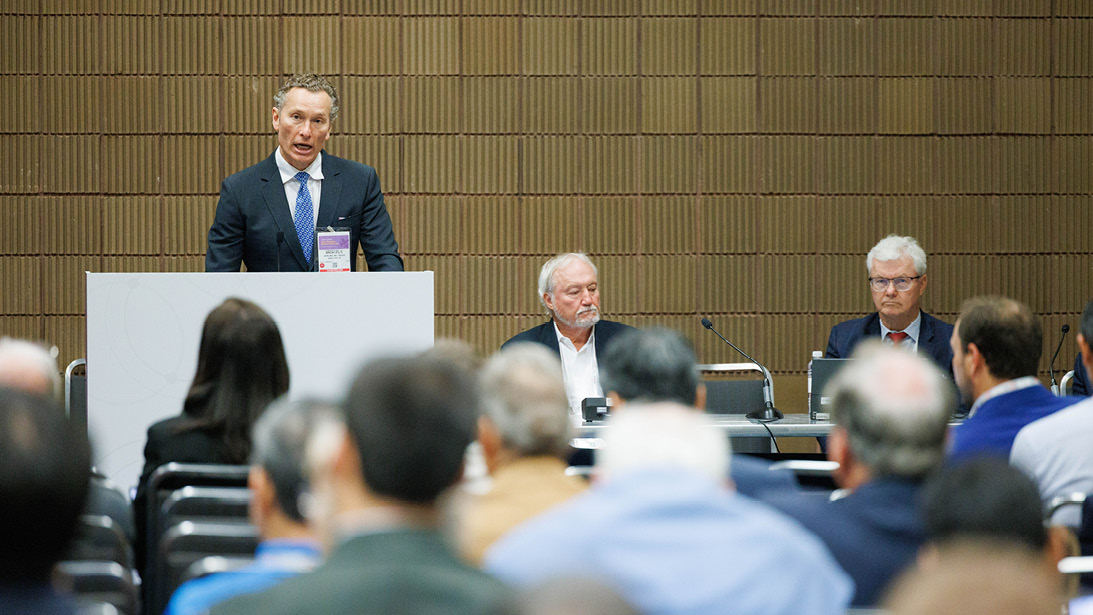
Michael Gerling, MD, FAAOS, discusses emerging biologic therapies and future directions in spine care during the North American Spine Society-sponsored Spine Biologics Instructional Course Lecture at the AAOS 2026 Annual Meeting in New Orleans.
Published 10/20/2026
|
Jennifer Lefkowitz
At a Glance
- Biologics may help address the underlying biology of spinal degeneration.
- BMP-2 remains the most studied osteobiologic for spinal fusion.
- Significant research and regulatory questions remain unresolved.
Estimated read time: 5 minutes
The use of biologics for complex spine disorders is one of the fastest-growing practices in spine surgery. However, advances in regenerative medicine continue to outpace the available evidence, leaving orthopaedic surgeons to balance innovation with uncertainties about efficacy, regulation, patient selection, and implementation.
At the AAOS 2026 Annual Meeting, the North American Spine Society (NASS) sponsored Instructional Course Lecture #223, “Spine Biologics,” featuring a panel of experts who reviewed the current landscape of biologics for spine disorders.
The panel discussed emerging technologies designed to promote regeneration rather than simply manage symptoms. They discussed current research and approaches to biologic therapies for degenerative conditions, post-traumatic injuries, genetic disorders, and inflammatory diseases. Topics included genetic and molecular approaches, cell-based treatments, scaffold use, and tissue engineering.
“The field of biologics is evolving quickly, and while many of these therapies and technologies are being explored for musculoskeletal disorders and peripheral joints, it is important to understand how they can also benefit patients with spine disorders,” said panelist Michael Gerling, MD, FAAOS, spine surgeon at the Gerling Institute in New York City.
---
Related Content
- Orthobiologics expands treatment for rotator cuff tears (AAOS Now)
- Orthobiologics for shoulder injuries: Distinguishing promise from science (AAOS Now)
- AAOS Biologics Dashboard (AAOS resource)
---
Biologics are a class of drugs that use human-derived products from living organisms in their components, such as proteins, peptides, nucleic acids, and cells, to manipulate or broadly alter activity in different systems. In spine care, they are being investigated for their ability to modify tissue healing and regeneration, often in combination with advanced scaffold technologies.
“Given the significant burden of back pain and disability, there is tremendous interest in developing treatments that can address the underlying degenerative cascade,” Dr. Gerling added.
In addition to Dr. Gerling, the panel of spine experts included Alan Hilibrand, MD, MBA, FAAOS, past president of the Cervical Spine Research Society and orthopaedic spine surgeon at the Rothman Institute in Philadelphia; John Finkenberg, MD, FAAOS, past president of NASS and orthopaedic surgeon with Alvarado Orthopaedic Medical Group in San Diego; and E. Jeffrey Donner, MD, FAAOS, orthopaedic surgeon at the Colorado Spine Institute in Johnstown.
Understanding the biology of degeneration
Several presenters emphasized that degenerative disc disease is driven by biologic changes long before structural collapse occurs.
Dr. Gerling described the degenerative cascade as a cycle in which inflammatory mediators cause disc cells to shift from an anabolic to a catabolic state, leading to their breakdown. As proteoglycans and type II collagen are lost, discs become dehydrated and lose their biomechanical integrity, resulting in instability and increased mechanical stress, which perpetuates the cycle.
Since disc degeneration is both a biological and mechanical disease, it can be a target for regenerative therapies, shifting the focus from symptom management to biological restoration to help relieve the pain associated with disc degeneration.
Novel biologic technologies for disc disease
Dr. Donner emphasized that successful treatment of degenerative disc disease requires more than addressing the disc itself.
Drawing on both his clinical experience and his own history of chronic lower back pain due to an injury as a springboard diver in college, he noted that back pain results from a combination of biologic, mechanical, and neurological factors.
“We need to consider treatment options other than just treating the disc,” said Dr. Donner. “If we can interrupt or slow down the degenerative cascade, even before a patient develops significant pain, we may be able to prevent the pain associated with instability and compression of the nerve roots. For example, the idea of metabolic imaging is very appealing and noninvasive for identifying metabolic markers, especially in the early disease process when interventions with disease-modifying biologic agents could help prevent the degenerative cascade.”
Although regenerative therapies continue to evolve, Dr. Donner cautioned that no biologic therapies currently have FDA premarket approval specifically for treating disc degeneration.
“There are a lot of great opportunities with cells, gels, nanotethers, peptides, decoys, and gene therapy,” he said. “But bringing these therapies into clinical practice is going to be really challenging.”
Osteobiologics for spinal fusion
Successful spinal fusion is contingent upon creating the right biologic environment to facilitate bone grafting and healing by combining osteoconductive, osteoinductive, and osteogenic properties.
Although the iliac crest bone graft remains the gold standard because it contains all three material characteristics, investigators continue to evaluate biologic alternatives that may enhance fusion while reducing donor-site morbidity.
Dr. Hilibrand urged surgeons to critically evaluate the growing body of literature surrounding commercially available osteobiologics.
“Buyers should still beware,” he said. “Many of the papers studying these products have highly conflicted authors. Orthopaedic surgeons should assume there is some degree of conflict and carefully evaluate the quality of the evidence, as it might provide a sense of what is actually going on.”
Among available biologics, bone morphogenetic protein 2 (BMP-2) remains one of the most extensively studied and contains the strongest body of evidence supporting its use as an osteoinductive biologic to enhance spinal fusion.
“BMP-2 is so good that it has had a chilling effect on development of other factors, and for good reason,” Dr. Hilibrand added. “Not only are the clinical outcomes impressive, but the basic science behind the development of the product is outstanding. We should apply that kind of criteria to every new osteogenic therapy.”
The panel also reviewed emerging technologies such as P-15-enhanced peptide-enhanced grafts, ceramic-based bone substitutes, cellular bone matrices, and stem cell-based therapies. Although early results are encouraging for the first two of these technologies, presenters emphasized that evidence varies, and many products require additional independent investigation.
Scaffolds and surface technologies
Dr. Finkenberg discussed novel biologic technologies for disc disease as well as current best practices and indications for genetic, molecular, cellular, and scaffold therapies.
He noted that platelet-rich plasma (PRP) is not necessarily a bone-healing solution and is only as effective as its composition, which varies with patient age, sex, health status, and current medications; blood characteristics; processing and centrifugation methods; and the timing and method of application.
Rather than relying on PRP injections alone, incorporating PRP into scaffolds can localize the treatment, provide structural support, prolong growth factor release, support stem cell survival, and create a 3D environment that more closely mimics natural tissue healing.
“In the future, we can likely expect to see living biomaterials, smart polymers, 3D bioprinting for all types of complex tissues, using sustainable alternatives like flavonoids, integrating synthetic biology, drug delivery, and regenerative medicine through nanotechnology and biomaterials that have sensing capabilities,” Dr. Finkenberg said.
Remaining challenges
Despite significant advances, the panelists and audience participants agreed that there is a greater need for more research and evidence before biologic therapies become routine components of spine care. Many of the most promising technologies remain investigational, and it remains unclear which biologic approaches, if any, will ultimately provide durable improvements for patients with chronic back pain.
Among the priorities discussed were:
- developing better methods to characterize and diagnose spinal degeneration and translating these technologies from the bench to clinical practice;
- defining the right patient population by creating specific patient criteria;
- establishing protocols and procedures — what to inject and where, and what additive to inject, such as hyaluronic acid;
- building higher-quality clinical evidence with firmer reporting of positive and negative outcomes; and
- continuing to evaluate the safety, dosing, complications, and cost-effectiveness of existing biologics, such as BMP-2 and P-15 peptides.
“I am encouraged by how far we have come in treating spinal degenerative disease over the past 30 years,” Dr. Hilibrand said. “We can successfully treat more patients with less surgical morbidity and better functional outcomes. However, there is much work still to be done to achieve the ‘holy grail’ of successful, definitive treatment of chronic low back pain.”
For now, most biologic treatments for spinal degeneration remain under investigation and are not routinely covered by third-party payers. This reality continues to limit widespread clinical adoption despite growing interest from both physicians and patients.
Jennifer Lefkowitz is a freelance writer for AAOS Now.