

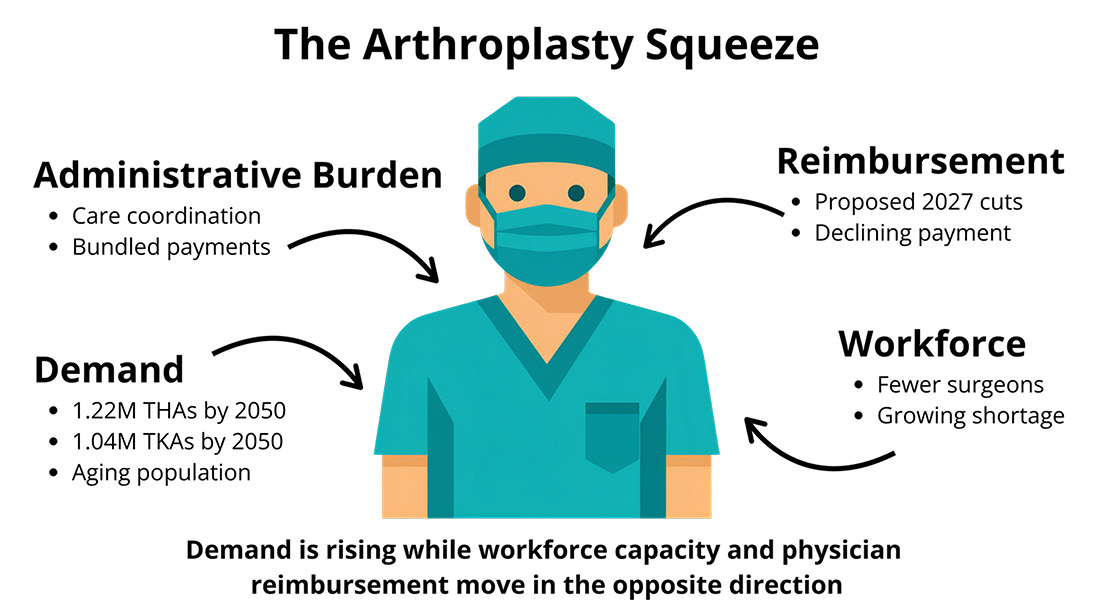
Multiple forces are converging on arthroplasty practices. Rising procedure demand, workforce shortages, expanding care-coordination responsibilities, and declining physician reimbursement may create increasing pressure on the future delivery of hip and knee replacement care.
Published 10/20/2026
|
Dhairya Shukla, MD, MPH; P. Maxwell Courtney, MD; Douglas W. Lundy, MD, FAAOS, MBA
At a Glance
- Proposed 2027 Medicare payment changes may significantly affect arthroplasty reimbursement.
- Continued reimbursement reductions could affect patient access to hip and knee replacement surgery.
- Workforce shortages and rising demand may amplify the impact of future payment cuts.
Estimated read time: 6 minutes
For millions of patients, total hip and knee arthroplasty can mean the difference between living with debilitating pain and returning to an active, independent life. The proposed reductions in Medicare reimbursement for these procedures could have consequences that extend far beyond surgeon compensation. By making it more difficult for practices and health systems to sustain access to arthroplasty care, these cuts risk limiting patients’ ability to receive timely joint replacement and may ultimately threaten the future workforce, innovation, and infrastructure needed to meet the growing demand for these life-changing procedures.
Total hip (THA) and total knee arthroplasty (TKA), which once required prolonged hospitalization, can now frequently be performed with same-day or next-day discharge. Patients are being medically optimized before surgery, leading to quicker recovery and fewer complications. At the same time, orthopaedic surgeons and their teams have assumed greater responsibility for coordinating care across the entire surgical episode. Against this backdrop, the Centers for Medicare & Medicaid Services (CMS) has proposed substantial changes to the valuation of total joint arthroplasty (TJA) for 2027. Both AAOS and the American Association of Hip and Knee Surgeons (AAHKS) describe the proposal as approximately a 20% reduction in physician payment for the primary THA and TKA codes. These changes come after years of declining Medicare reimbursement for orthopaedic procedures and additional proposed changes to the valuation of surgeon work and practice expenses. While the inflation-adjusted Medicare reimbursement for THA and TKA has declined by approximately 56% from 2000 to 2024, the economic burden of arthroplasty care has remained substantial because implant, perioperative, and hospital service costs continue to drive overall episode expense. Continued reimbursement cuts ultimately risk worsening a structural patient access problem in arthroplasty and impair the future delivery of high-quality hip and knee replacement care.
Multiple forces are converging on arthroplasty practices. Rising procedure demand, workforce shortages, expanding care-coordination responsibilities, and declining physician reimbursement may create increasing pressure on the future delivery of hip and knee replacement care.
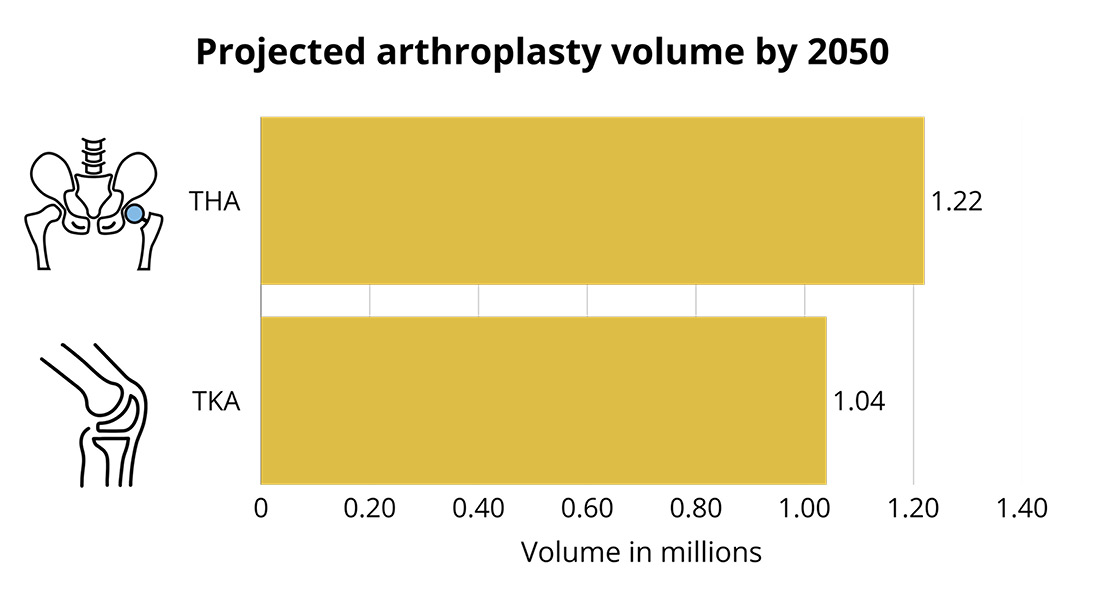
Annual TJA volume is projected to reach approximately 1.22 million total hip arthroplasties (THAs) and 1.04 million total knee arthroplasty (TKAs) by 2050, while the number of orthopaedic surgeons is projected to decrease 14% from 2020 to 2050.
Source: Data adapted from Rullán PJ, Deren ME, Zhou G, et al. The arthroplasty surgeon growth indicator: a tool for monitoring supply and demand trends in the orthopaedic surgeon workforce from 2020 to 2050. J Bone Joint Surg Am. 2023;105(13):1038-1045. doi:10.2106/JBJS.22.00874.
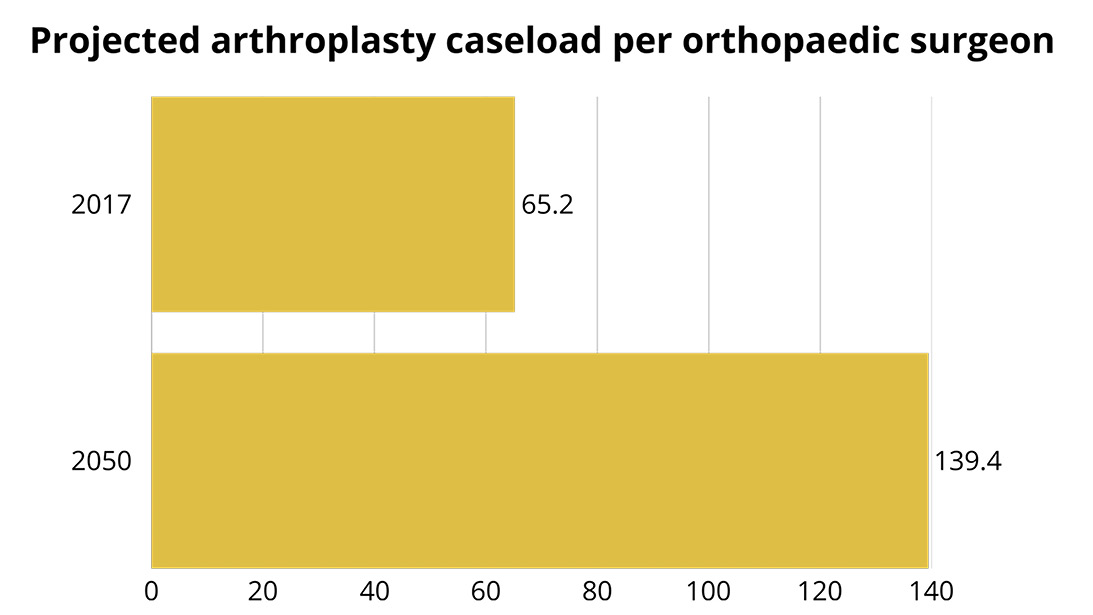
By 2050, the average arthroplasty caseload per surgeon is projected to more than double.
Source: Data adapted from Rullán PJ, Deren ME, Zhou G, et al. The arthroplasty surgeon growth indicator: a tool for monitoring supply and demand trends in the orthopaedic surgeon workforce from 2020 to 2050. J Bone Joint Surg Am. 2023;105(13):1038-1045. doi:10.2106/JBJS.22.00874.
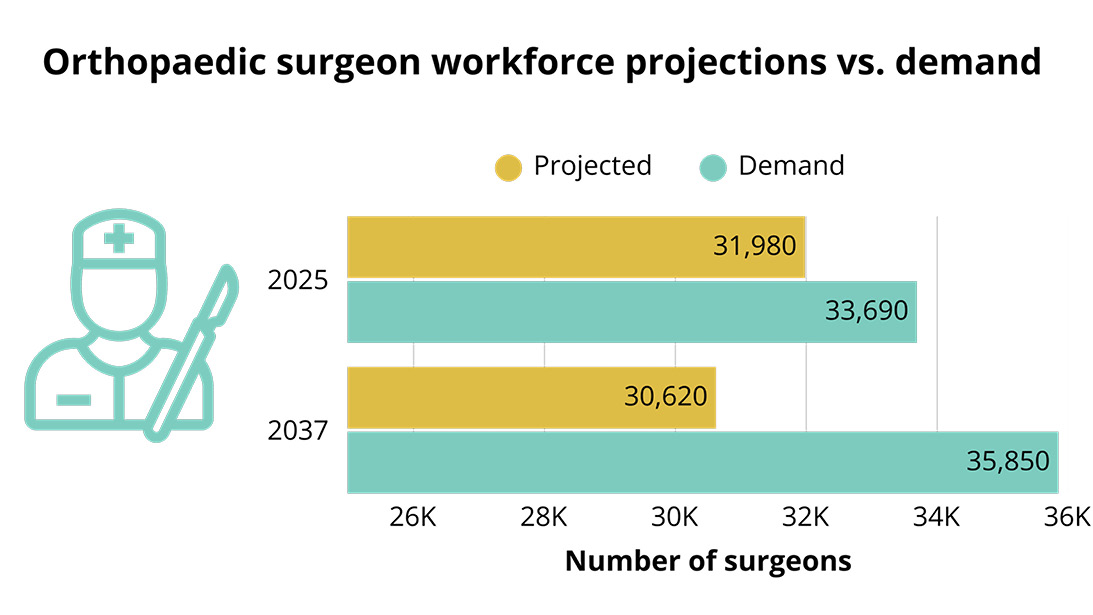
Projected arthroplasty demand is expected to grow substantially while the orthopaedic surgeon workforce remains relatively constrained.
Source: Data adapted from Rullán PJ, Deren ME, Zhou G, et al. The arthroplasty surgeon growth indicator: a tool for monitoring supply and demand trends in the orthopaedic surgeon workforce from 2020 to 2050. J Bone Joint Surg Am. 2023;105(13):1038-1045. doi:10.2106/JBJS.22.00874.
The economics of arthroplasty have changed
The economics of joint replacement were built around a model in which much of the patient’s care occurred inside the hospital. That model has changed dramatically. Surgeons and their teams now evaluate whether a patient is an appropriate candidate, address modifiable medical risks, coordinate with other physicians, educate patients about recovery, perform the surgery, and manage the postoperative course. The AMA Relative Value Scale Update Committee (RUC) justified a reduction in work Relative Value Units because patients are spending less time in the hospital. Instead, work has shifted to the period before surgery and to outpatient care following discharge. In fact, a study by Grosso et al. found that surgeons and qualified healthcare providers reported an average of 153 minutes of preoperative work that was not captured by existing Current Procedural Terminology or hospital billing codes. Telephone encounters and electronic medical record real-time communication have replaced in-hospital visits and have strongly improved the patient experience, yet no reimbursement metric currently values the amount of time surgeons or their staff spend communicating with patients in the outpatient setting. CMS, unfortunately, has stated that the RUC cuts did not go far enough. As Medicare primarily uses reductions in hospital-based utilization to determine the value of the surgical episode, it fails to capture the work required to safely achieve those efficiencies.
Orthopaedic surgeon burnout is already highly prevalent and is driven by excessive workload, loss of job control, administrative burden, and financial stress. Continued reductions in surgeon work valuation risk worsening an existing workforce vulnerability with downstream effects on surgeon retention, practice sustainability, and patient access.
The federal administration has stated that they want to shift reimbursement from specialists to primary care. We all agree that our primary care physician colleagues are undervalued and deserve fair compensation, but the problem lies with strict budget neutrality rules around CMS reimbursement.
By statute, the Physician Fee Schedule is cost-neutral, a zero-sum game. If Medicare continues to cite decreasing in-hospital utilization as justification for lowering the surgeon’s payment, the system also risks sending an unintended message: improving efficiency can lead to lower reimbursement. This consequence is particularly concerning when the surgeon’s fee represents less than 4% of the overall cost of an arthroplasty episode. While the professional fee has continued to decline, facility payments for THA and TKA are on the rise, with hospital outpatient reimbursement set to increase 10% and ASC reimbursement 5% in 2026.
---
Related Content
- Meet the committee looking out for your bottom line: AAOS Coding Coverage & Reimbursement (AAOS Now)
- Hip replacement: Payment flows shape care decisions (AAOS Now)
- The effects of today’s economic realities impact tomorrow’s orthopaedic workforce (AAOS Now)
---
Efficiency has reduced hospitalization, not surgeon work
Due to a shift toward outpatient care, a United Healthcare study noted that arthroplasty surgeons have reduced 900,000 unnecessary inpatient hospitalizations for THA and TKA, saving the system $6 billion in 2025, with a projected $70 billion in savings in the next decade.
Arthroplasty surgeons have also been at the forefront of value-based care, leading CMS models such as Bundled Payments for Care Improvement and Comprehensive Care for Joint Replacement, where efficiency has resulted in marked cost savings for CMS yet reduced reimbursement for physicians. THA and TKA will also be the first procedures to be included in a nationwide mandatory bundled payment program with CMS in 2028, which will require substantial work on the part of surgeons and their staff. Further reducing the professional fee will have little effect on the overall cost of healthcare while substantially affecting the economics of the practices responsible for delivering the care.
Orthopaedic practices operate with substantial expenses, including clinical staff, malpractice coverage, facilities, technology, and administrative infrastructure. Medicare reimbursement that fails to keep pace with these costs can make it increasingly difficult for independent practices to maintain the same level of service. Historically, surgeons have responded to reimbursement cuts by increasing volume; however, we are at a breaking point. A 20% cut may have the downstream effect of more surgeons refusing to take Medicare, limiting the number of Medicare patients they accept, or driving consolidation by joining larger healthcare organizations. Each of these responses has potential consequences for patients.
In communities with relatively few orthopaedic surgeons, even the loss of one independent practice could meaningfully affect access. Independent orthopaedic practices have historically provided patients with an alternative to large health systems. Continued reductions in physician reimbursement may make that model increasingly difficult to sustain. As independent practices consolidate, patients have fewer opportunities to choose among competing surgeons, particularly in markets where only a small number of orthopaedic groups remain.
Fewer Medicare patient slots mean a Medicare patient with debilitating hip or knee arthritis may have to wait longer for an appointment or surgery, extending the amount of time someone may be unable to work, exercise, drive, or remain independent due to the severe pain and suffering. A study by Clement et al. demonstrated that each additional month spent waiting for a total hip or knee arthroplasty is independently associated with a decrease in the quality of life while another study by Scott et al. demonstrated that 19% of patients awaiting THA and 12% awaiting TKA are in a health state “worse than death” based on the EuroQol five-dimension (EQ-5D) questionnaire. The downstream impact on patient wait times and access to care is not benign.
Workforce shortages may worsen
The implications of this CMS proposal also extend beyond today’s practices. This fall marks the beginning of another application cycle for adult reconstruction fellowships, at a time when the specialty is facing both rapidly increasing demand and growing uncertainty surrounding physician reimbursement. In a Journal of Bone & Joint Surgery model, annual TJA volume is projected to reach approximately 1.22 million THAs and 1.04 million TKAs by 2050, while the number of orthopaedic surgeons is projected to decrease 14% from 2020 to 2050 (Figure 1).
The projected arthroplasty caseload per orthopaedic surgeon will increase from 65.2 TJAs in 2017 to 139.4 TJAs by 2050, effectively doubling the required per-surgeon arthroplasty burden (Figure 2). Similarly, federal workforce projections indicate the orthopaedic surgeon supply is projected to fall from 31,980 to 30,620 full-time equivalents (FTEs) between 2025 and 2037, while demand rises from 33,690 to 35,850 FTEs (Figure 3). Choosing a career in adult reconstruction requires additional training, and surgeons entering the field are making career decisions based not only on clinical interest but also on the long-term sustainability of the profession. Continued reductions in reimbursement and repeated devaluation of surgeon work may alter the incentives for surgeons to pursue and remain in arthroplasty, particularly in areas where Medicare represents a substantial portion of the patient population.
The future of arthroplasty depends on payment reform
Ultimately, the 2027 CMS proposal is concerning for all orthopaedic surgeons, not just for hip and knee arthroplasty surgeons. Shoulder surgeons are also facing approximately 20% cuts to both total and hemiarthroplasty procedures of the shoulder. Together, the cuts in this CMS proposal raise fundamental questions about how musculoskeletal care will be delivered and valued in the United States. If the delivery of care has changed, the methodology used to value that care must change with it. The profession needs payment structures that reward the entire process of delivering high-quality care — from appropriate patient selection and optimization through surgery, recovery, and restoration of function. Arthroplasty has demonstrated that medicine can simultaneously improve outcomes and reduce the resources required to deliver those outcomes. That success should be reinforced, not inadvertently penalized.
The challenge for CMS and organized orthopaedics is therefore not simply determining what a hip, knee, or shoulder replacement should cost but also determining how to build a payment system that allows surgeons to continue delivering the efficient, high-quality care that patients have come to expect. The future of arthroplasty should reward progress — not make access to that progress harder for the patients who need it most.
Dhairya Shukla MD, MPH, is a fourth-year resident within the Department of Orthopaedics at St. Luke’s University Health Network in Bethlehem, Pennsylvania.
P. Maxwell Courtney, MD, is an orthopaedic surgeon at Rothman Orthopaedics. He serves as an associate professor of orthopaedic surgery at Thomas Jefferson University and chair of the AAHKS Advocacy Committee.
Douglas W. Lundy, MD, MBA, FACS, FAAOS, is chair of orthopaedic surgery and chief of orthopaedic trauma surgery at St. Luke’s University Health Network in Bethlehem, Pennsylvania. He is also the deputy editor of AAOS Now and a member of the AAOS Now Editorial Board.
References
- Centers for Medicare & Medicaid Services. Calendar Year (CY) 2027 Medicare Physician Fee Schedule Proposed Rule. https://www.cms.gov/newsroom/fact-sheets/calendar-year-cy-2027-medicare-physician-fee-schedule-proposed-rule. Published July 14, 2026. Accessed August 27, 2026.
- Palmer R, Elmenawi KA, Lieberman JR, Heckmann ND, Hannon CP. Medicare reimbursement for primary and revision total hip and knee arthroplasty: an updated analysis from 2000 to 2024. J Arthroplasty. 2025;40(9 Suppl 1):S100–S104.e1. https://doi.org/10.1016/j.arth.2025.04.034
- Grosso MJ, Courtney PM, Kerr JM, Della Valle CJ, Huddleston JI. Surgeons’ preoperative work burden has increased before total joint arthroplasty: a survey of AAHKS members. J Arthroplasty. 2020;35(6):1453-1457. doi:10.1016/j.arth.2020.01.079
- Krueger CA, Austin MS, Levicoff EA, Saxena A, Nazarian DG, Courtney PM. Substantial preoperative work is unaccounted for in total hip and knee arthroplasty. J Arthroplasty. 2020;35(9):2318-2322. doi:10.1016/j.arth.2020.04.066
- Chahal K, Matwala K. A systematic review of the prevalence of burnout in orthopaedic surgeons. Ann R Coll Surg Engl. 2025;107(1):61-67. doi:10.1308/rcsann.2024.0009
- Lu S, Mc Colgan R, Nguyen J, Kelly BT, Fufa DT. Worsening burnout in orthopedic surgeons since 2019 and key areas of work life drivers. HSS J. 2025;21(2):138-145. doi:10.1177/15563316241242129
- Scott CEH, MacDonald DJ, Howie CR. ‘Worse than death’ and waiting for a joint arthroplasty. Bone Joint J. 2019;101-B(8):941-950. doi:10.1302/0301-620X.101B8.BJJ-2019-0116.R1
- Clement ND, Scott CEH, Murray JRD, Howie CR, Deehan DJ. The number of patients “worse than death” while waiting for a hip or knee arthroplasty has nearly doubled during the COVID-19 pandemic: a UK nationwide survey. Bone Joint J. 2021;103-B(4):672-680. doi:10.1302/0301-620X.103B.BJJ-2021-0104.R1
- Rullán PJ, Deren ME, Zhou G, et al. The arthroplasty surgeon growth indicator: a tool for monitoring supply and demand trends in the orthopaedic surgeon workforce from 2020 to 2050. J Bone Joint Surg Am. 2023;105(13):1038-1045. doi:10.2106/JBJS.22.00874
- Silvestre J, Kelly JD, Seeger S, et al. Analysis of United States federal government projections on anticipated shortages in the orthopedic surgeon workforce. Orthopedics. 2026;49(1). doi:10.3928/01477447-20251124-01
- Patel RV, Gonzalez MR, Attaar N, Patel MV, Lozano-Calderon SA. Analyzing orthopaedic workforce trends in an ever-changing landscape. J Am Acad Orthop Surg. 2025;33(14):780-786. doi:10.5435/JAAOS-D-24-00797
- UnitedHealth Group. The successful shift of joint replacement surgeries from hospital inpatient to outpatient settings is saving the health care system $6 billion this year and will save $70 billion over the next decade. Published June 2025. Accessed August 27, 2026. https://www.unitedhealthgroup.com. June 2025.